From time to time, I’ve cited many Enterprise Agentic AI success stories e.g.:
- Bajaj Finance: Agentic AI powers 10% of quarterly loan disbursements, worth Rs. 1,600 crore, by analyzing millions of calls and creating tailored offers that added Rs. 325 crore in volumes.
- DBS: Inhouse AI agent built on top of ChatGPT cuts down KYC and onboarding of private wealth management customers from days to hours.
- Sanofi: Inhouse AI agent built over Claude Code performs work previously handled by ServiceNow ITSM software.
“Enterprise adoption of AI is very slow.” – Mohit Joshi, CEO, TechMahindra.“AI adoption has not been smooth sailing in larger businesses. AI labs haven’t built a product that boosts productivity for most white-collar workers.” – Ramp AI Index via FORTUNE EYE ON AI newsletter.
Notwithstanding these sporadic case studies, Agentic AI has not exactly set the enterprise technology space on fire.
Personally, I haven’t had any success with Agentic AI.
As many readers would know, GTM360 has been running a bimonthly newsletter for close to 10 years. It takes 40+ steps to produce each issue of the newsletter. The end-to-end workflow crisscrosses desktop, blog, email service provider, and other environments.
I’ve been trying to automate the production of these newsletters for years. I attempted RPA (Robot Process Automation). I gave up when I found out that it cost at least $80,000. When Agentic AI burst on the scene around two years ago, I gave it a shot. But I still haven’t made any headway. In How AI Can Propel Personalization To A Higher Orbit, I predicted:
Agentic AI can go beyond personalizing the campaign and run the whole personalized marketing campaign on its own. That will be the topic of a follow-on post. Watch this space!
More than a year later, that follow-on post has not yet been written – because my super-optimistic prediction hasn’t aged well, and this newsletter continues to be produced manually as before.
One could say that I haven’t tried Agentic AI seriously enough. One wouldn’t be wrong.
But the point is I haven’t tried Generative AI / Large Language Model – the bedrock of Agentic AI – any more seriously, but I can still boast of several success stories of it.
| Use Case | Before ChatGPT | With ChatGPT |
|---|---|---|
| Spreadsheet → actionable data analysis | For more than a decade, I’d been searching for a software or website to which I could simply upload an Excel file and have it analyze the data and discover insights automatically. I tried Excel Pivot Tables, DataRobot and Gartner’s Smart Data Discovery products. They required too much manual data preparation work and still didn’t work as advertised. | I uploaded the raw XLS file to ChatGPT and prompted it for actionable insights. I got them instantly. |
| Blog semantic search | I had tried WordPress Search, Algolia, and Miso.ai to find a post on my blog based on its theme. None of them helped – they all worked on the basis of exact keywords that I couldn’t remember. | My prompt “Can you find the post where I’ve written about whether to broach the topic of price early or late in the sales cycle?” yielded the correct blog post Should Sales Dodge The Price Question Or Answer It Upfront? in seconds. |
| Stock-price lookup for Excel portfolio tracker | I had tried Excel web scraping on Google Finance / Yahoo Finance websites. The output was fragile and required repeated manual cleanup. | ChatGPT gave me the step-by-step instructions to create the Excel-to-Google Finance web link, which worked perfectly. |
| Coding | Given my dubious coding skills, I had struggled to make responsive design tables in my WordPress blog posts. My attempts to write the HTML code by hand and use table plugins both produced meh results. | I make tables easily on Microsoft Word, upload the DOC file to ChatGPT, and ask for the HTML code for an equivalent table in WordPress. I copy whatever code ChatGPT gives me and blindly paste it in the “Code” view of WordPress editor. Always works! |
(Click on the use case link to find out more details of each case study.)
On the contrary, I can’t claim even one success story with Agentic AI.
It’s not only me.
I’ve line of sight into 100+ prospects and customers of enterprise AI. All of them use genAI (ChatGPT or Claude mostly) extensively. Around 20 companies kicked off Agentic AI initiatives, but the going is, how shall I put it, not great.
So far, I only had personal experience and anecdata about the lukewarm adoption of Enterprise Agentic AI.
Now, there’s research data. According to a recent report by Big-4 consulting firm KPMG, many Agentic AI projects have been put on hold or aborted.
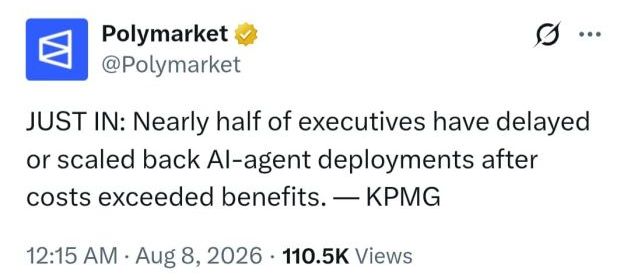
Pundits have advanced many reasons to explain the lacklustre adoption of Agentic AI e.g. data quality, security concerns, hallucination, non-deterministic nature, lack of ROI, etc.
I don’t disagree with any of them but I think the RCA in the public discourse misses the elephant in the room: Severe GTM Disconnect. More specifically, mis-selection of use cases.
Well-built conventional models are already cheap, transparent, fast and easy to explain. Agentic AI models bring inference cost, latency, hosting/vendor dependency, and limited interpretability. Even if the accuracy gain over a well-tuned statistical model is real, the operational cost may not be worth it. ~ Evident Insights.
Most Agentic AI use cases I’ve come across sound amateurish to me. By pitching customer service, fraud detection, loan underwriting, payments, etc., Agentic AI vendors are pretending as though Agentic AI invented automation.
This is obviously disingenuous. Through the decades, enterprises have used RPA and other automation technologies to automate many business processes including all of the above mentioned low hanging fruits of Agentic AI.
This implies that the real opportunity for Agentic AI is brownfield i.e. replacement of existing automated workflows.
However, the current GTM of Agentic AI vendors targets a greenfield opportunity i.e. automation of workflows from scratch.
This is a critical disconnect and I attribute the sluggish adoption of Agentic AI to it.
Let me take the last use case to illustrate how the disconnect is playing out in the real world.
A Top 5 bank in UK offers TARGET-2 payments to its customers in UK and EU. These are high value RTGS payments (running into tens or even hundreds of billions of EUR each). For over 15 years, the bank has been using a high value fund transfer system that’s built with traditional automation technologies. On a typical day, the HVFT system processes 80,000 payments. Out of them, 76,000 go through the Straight Through Processing route with zero human touch, whereas 4,000 are swept to the repair queue to be handled manually. In the payments industry parlance, this payments shop has 95% STP Rate.
By pitching payments as a use case, an Agentic AI vendor is targeting all 80,000 payments (greenfield opportunity). Obviously, most banks would reject it since their existing system already runs 76,000 of them without human intervention.
If instead the vendor were to target just the 4,000 payments in the repair queue (brownfield opportunity), the bank would respond to its Agentic AI solution more favorably.
Notice that there’s a 20X difference between these two TAMs – 80,000 versus 4,000.
tl;dr: Payments is not a compelling GTM, only a small fraction of it (5%) is.
5/7 tl;dr: Banks have been using technology to automate workflows in a bid to increase STP rates (and thus reduce operating costs) for decades.
— GTM360 (@GTM360) December 27, 2025
As for why Agentic AI vendors use their present GTM, I can only speculate.
One possibility is that they’re largely staffed with people below a certain age. Like Millennials / Yoomers and Gen Zers (Zoomers) tend to believe that all great things in the world were invented in their generation, their workers might genuinely believe that Agentic AI invented automation. (We’ve seen this in the disruption posturing of fintechs.)
The other possibility is that enough of their workers are aware of the 20X difference between the projected TAM and actual TAM but they deliberately target the market of 100 instead of 5 in order to drive nosebleed valuations for their companies. When they do that, 95 out of 100 use cases will obviously not deliver value, thus vindicating the findings of the aforementioned KPMG study.
But that’s okay. It’s still very early days of the Technology Adoption Life Cycle of Agentic AI, and markets care only about adoption, which is high because the vendor is targeting the projected TAM of 100. By the time the market recognizes the disconnect and starts caring for value, it’s quite possible that the fast-evolving technology will become more powerful and find many new use cases, which will multiply the actual market of 5 by 20 times to 100 or more.
As they say, Edison invented electricity in the 1870s but it took another 70 years for the full range of electrical appliances to appear in American homes in the 1940s.
Called “Fake It Till You Make It“, this is a charter principle of Silicon Valley. It has been used with almost all technologies of the past. I won’t be surprised if it’s now being used for Agentic AI.
Whether Anthropic’s TAM is a scam (is) beside the point. According to AI soothsayers, there are new kinds of work and businesses emerging – and that spells opportunity, TAM be damned. https://t.co/DkUgrSrkPH – @editorialiste via @FortuneMagazine
— SKR (@s_ketharaman) August 29, 2026
Agentic AI is moving very rapidly. Anything can happen anytime. Don’t blame me if the industry sees some new breakthrough next month and I say something contradicting this post after a few months!
One of the most important things to know about this AI cycle is that no one knows what they’re talking and even very smart and plugged in people are continually reversing their opinions and then re-reversing them three months later.
— Jack Altman (@jaltma) August 28, 2026