In my blog post entitled Make Index In India, I’d predicted:
It’s a fool’s errand to try to cross someone else’s bar. For all we know, once we get too close to the finishing line, they just might move the goal post, leaving us back in square one.
Well, my prediction has come true!
According to the op-ed entitled What To Rank And File Away in Economic Times dated 1 August 2026, Indian higher education institutes ramped up research in line with the high weightage given for it in QS ratings all these years.
Their efforts have borne fruit.
In the latest QS World University Rankings 2027 published in June 2026, IIT Delhi scored 97.3 on “Citations per Faculty” metric, which is the most representative indicator of research. Peking University scored 99.2 and University of Hong Kong scored 98.7.
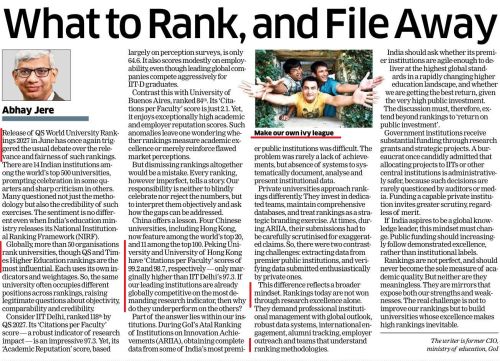
But the results have not.
Given that IITD scored just a whisker behind the two Chinese universities on this key metric, it should follow that its overall rank is also just a whisker behind them, right?
No.
The QS Ranks are as follows:
- Peking University: 13
- University of Hong Kong: 11
- IIT Delhi: 118.
IIT Delhi is ranked far behind the other two universities even though it ranks very favorably on R&D.
What gives?
QS seems to have moved the goal post, which is what I’d predicted would eventually happen when an Indian university caught up with it.
In the latest QS rankings, R&D no longer carries as much weightage as it used to. Two other factors carry greater weightage now:
- Academic Reputation
- Employability
IIT Delhi has scored poorly on both, and hence got relegated to the 118th rank.
In response to the ratings, the public discourse is full of knee jerk reactions:
- Protest to QS
- Ignore QS
- Dismiss market perception as flawed.
All these are recipes for disaster.
As I pointed out earlier:
Index building organizations are stuck in their ways and it’s futile to make them accept that there are many ways to skin the proverbial cat. So pushing back is pointless.
So protesting to QS is not going to help.
Rankings like QS influence student preference and research grants, so ignoring them is suicidal.
Perception is reality in business. With higher education behaving no different from any other business, the sector should learn to treat perception as gospel truth. Calling it flawed is the most daft thing the industry can do. In fact, Indian higher edu industry needs to change itself so that its perception improves (whether the intrinsics improve or not is secondary in the short and medium term.)
What should India do?
It should not only make its own index, as I’d suggested in my previous post, but accelerate the process of doing so.
I’d already proposed the basic playbook for creating an Indian index in Make (Index) In India. I’ve just one more thing to add now:
Universities should staff their teams with people who understand ranking methodologies.
Because
What gets measured gets gamed – Goodhart’s Law.
It’s better to lie on the right side of the game and win now than be on the wrong side of the game and whine later!
Lie Now Whine Later: Take it lying down when they harm you. Whine about it after 500 years. #LNWL
— SKR (@s_ketharaman) May 26, 2022
On a side note, there’s a graphic in the article captioned “Make our own Ivy League”.

It’s not accompanied by any text in the body of the article. Thank goodness.
For reasons I explained in Harvard Mumbai: Innovative Or Harebrained?, this is a very bad idea and should not be attempted, at least not with taxpayer dollars.