One of the hottest use cases of AI in Marketing is Personalization.
The dictionary meaning of personalization is as follows:
Personalization: The action of designing or producing something to meet someone’s individual requirements e.g. the goal of search personalization is to help the searcher save time.
In the context of marketing, I’ll slightly rephrase this to
Personalization: doing something that resonates with the customer’s specific attributes.
where
- “doing something” is creating TOFU marketing communications such as direct mail, email flyer, targeted offer / next best offer, social media post, website landing page. (for the uninitiated, TOFU = Top of Funnel)
- Customer can be company as well as employee
- Attribute includes name, firmographics, demographics, psychographics.
Personalization is almost as old as Artificial Intelligence although both fields received a big boost since the advent of Generative AI in the end of 2022 (when OpenAI launched ChatGPT).
In the late 1980s, before Microsoft Word was a glint in Bill Gates’s eye, we personalized customer correspondence by using the mail merge feature in WordStar e.g.
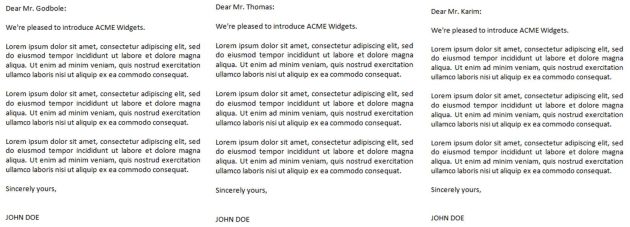
(For the uninitiated, WordStar, along with WordPerfect, were the two most popular wordprocessing software packages before Word dislodged them from the top of the totem pole.)
As you can see, the body of the letter was the same but each letter was individually addressed by the customer’s name.
While the WordStar mail merge feature was powerful enough to personalize other elements of the letter, it was quite painful to use, so most people stopped at personalizing the name of the recipient.
In the next generation of personalization, with Microsoft Word, we personalized other elements of the letter – or email, which had already become mainstream by then – by using “business logic”. For example:
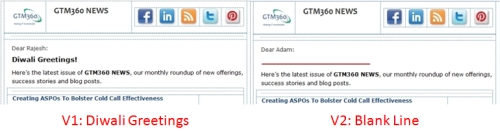
- We personalized our monthly email newsletter to include a Diwali Greeting to some recipients and leave that line blank for other recipients. See How A Small Problem In Mail Merge Led To A Big Lesson In Content Marketing for more details.
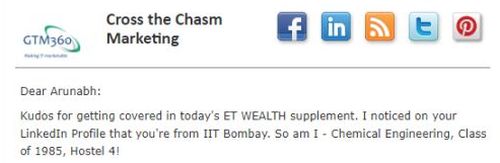
- We ran a campaign where the first paragraph was personalized to founders who graduated from IIT Bombay.
One of our customers has a Customer Engagement Management software, which lets brands make targeted offers based on firmographics, demographics, psychographics, and purchase history. It helps personalization to scale new heights.
On a side note, while personalization has made major strides in the last 40 years, J6P (Joe / Jane Six Pack aka Common Man / Woman) still thinks of it as just addressing recipients by name. This is one of those software feature adoption behaviors that has not changed in the four decades that I’ve been in this industry. More on that in a bit.
Personalization in the above examples is indexed on business rules e.g.
-
-
- If recipient is Hindu or Indian, include Diwali Greeting line, else leave the line blank.
- If recipient is an alumnus of IIT Bombay, include line about me, else leave the line blank.
- If recipient has a hotel-related spend on their credit card statement, send them a targeted offer for AirBnB, else do nothing.
-
These rules are decided by the marketer and configured on the tech stack used for creating and delivering the comms.
In addition, the marketer supplied the following data to the software:
-
-
- Recipient is Hindu
- Recipient is IITB alum
- Recipient had a hotel-related spend on their credit card statement.
-
Enter AI.
Artificial Intelligence / Machine Learning (henceforth AI for the sake of simplicity) can:
-
-
- Find the data. By using its pretrained data and by accessing third party data brokers, AI will find out whether e.g. recipient is an alum of IIT Bombay.
- Generate personalized text and imagery for the communication in the style of the individual customer’s tastes and preferences.
- Measure conversion rates of each wave of the targeted offer campaign and recommend ways to improve the effectiveness of the next wave of the campaign by e.g. tweaking the content, changing the image, altering the color of CTA, sending the communication on a different day and / or different time, etc.
-
In this manner, AI can propel personalization to a higher orbit.
Whereas technology in the past was more based on static logic, true AI adapts dynamically, learning from behavioral signals, context and intent. It’s about moving beyond static “if-then” logic to something truly intelligent – Martech.
I don’t get why people are upset about ads in AI.
IMO targeted ads are great!
Ads help businesses find customers & help users discover things they actually want; I’m excited for better targeting.
Google makes $575/yr per US user, Meta makes $310. https://t.co/VCU0oNMq6g
— Sheel Mohnot (@pitdesi) May 6, 2025
Here’s a real life example of AI-driven personalization by the leading American beauty products retailer Ulta Beauty:
… another key partnership is with software company Adobe. The goal is to work together to leverage the data of Ulta Beauty’s 44.6 million loyalty program members and present them with more personalized marketing messages. While the project is still fairly new, Ulta wants to generate unique images and text so that shoppers who visit the company’s website or app will see a mix of goods based on their past history along with the products that Ulta wants to pitch. Generative AI tools can make it easier to create more of that personalized content. – CIO Intelligence Newsletter @ FORTUNE magazine.
One word of warning: Unlike the deterministic rules used by humans for personalization, AI – especially generative AI – is a stochastic / non-deterministic system, ergo its output may have errors, hallucinations, inconsistencies, and so on. To that extent, marketers may not trust AI fully and will want to put a “human in the loop” to verify the elements of personalization generated by AI before approving the campaign for delivery.
Over time, as the fidelity of AI improves, we can expect the human to be taken out of the loop.
On a side note, ARS TECHNICA has a cautionary tale for celebrities who sold rights to their images to AI companies:
some… actors are regretting selling their likenesses to be used in AI videos that they consider embarrassing, damaging, or harmful.
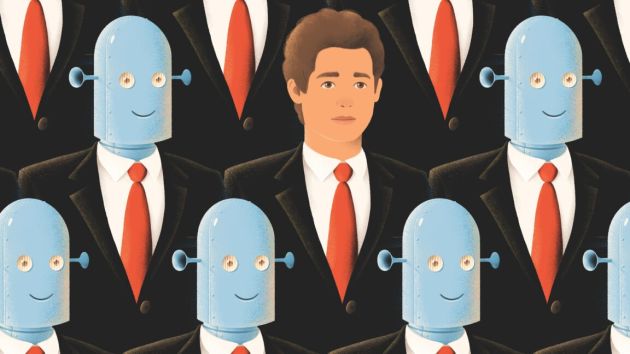
Personalization itself is very old. What AI does is to make the activity faster, better, and cheaper. To that extent, AI is not enabling a new JTBD (Job To Be Done) but taking an existing JTBD to the next level of quality, throughput and speed. This is a nod to the essence of my blog post titled Technology Matters – Just Not At The Top Of Funnel.
This post focused on the role of AI – more specifically genAI – in personalizing marketing campaigns.
Agentic AI can go beyond personalizing the campaign and run the whole personalized marketing campaign on its own. That will be the topic of a follow-on post. Watch this space!