Every few months, there’s an AI breakthrough from USA or China, which triggers another round of hand-wringing in India.
The latest example is Kimi K3, a frontier LLM model released by Beijing-based company Moonshot AI last month. Kimi K3 is widely regarded as rivaling the performance of the best American models. As a Free Open Source Software, it’s available as a free download.
As in the previous meltdowns, the latest one has prompted the familiar questions:
- Why can’t India build something like this?
- Are we falling behind?
In my opinion, these are irrelevant questions.
India can still become a $10 trillion economy without leading the world in every frontier technology. As economist Dhiraj Nayyar argued in his oped in Economic Times, India has enormous room to grow by doing more of what it already does well and additionally by capturing manufacturing of the nature that China is gradually becoming less competitive in.
The real issue worth losing sleep over is whether the Indian economy can consistently deliver double-digit growth. Whether it does it via services or by inventing the next jingbanggizmo technology is secondary. I made this argument in my blog post Innovate Now, Invent Later.
Then there’s another uncomfortable historical fact that often gets overlooked in all this “India must do this, India must do that” public discourse. When China’s economy was roughly India’s size about two decades ago, it was not known for cutting-edge fundamental research. Instead, it acquired technology aggressively, often by copying or stealing intellectual property from Silicon Valley.
Huawei’s rise is a classic example. Today, Huawei is larger than Cisco in several businesses. But in the late 1990s, it allegedly got its start by copying Cisco’s router software, including source code and even bug codes. This history is documented in numerous reports, including analyses of how China accelerated its R&D capabilities through widespread IP appropriation. More at How China Primed Its R&D Pump With IP Theft.
None of this is to justify intellectual property theft but to call out the sequence followed by many countries so far: Copy / Reverse Engineer existing technologies —> Manufacture —> Commercialize —> Do frontier research.
India’s trajectory has been different here.
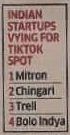 When GoI banned the Chinese short video app TikTok, the move created a once-in-a-generation opportunity for Indian entrepreneurs. Several well-funded domestic short-video applications emerged almost overnight – e.g. Mitron, Chingari, et al per exhibit on the right – and enjoyed a level of protection that startups in most markets could only dream of.
Yet none of them could compete with Instagram Reels or YouTube Shorts. Today, those two American apps dominate the short video space in India.
That episode says something important. Despite favorable conditions, India did not produce a globally competitive consumer internet product. This may be uncomfortable to acknowledge, but perhaps fundamental invention is not India’s strongest suit.
And that’s perfectly fine.
India is already the world’s leading IT services outsourcing hub. Indian companies have globally valuable capabilities in software engineering, systems integration, consulting, digital transformation, enterprise services, and increasingly AI deployment. These are nothing to sneeze at – they’ve become businesses that generate GDP, exports, employment, and wealth.
Business 101 teaches us to double down on strengths rather than obsess over weaknesses. That’s what India should do.
Instead of whipping ourselves up for every breakthrough coming out of Silicon Valley or China, India should focus on expanding the sectors where it already enjoys a durable competitive advantage.
There is nothing unambitious about that strategy. In fact, it may be the fastest route to becoming a high-income economy.
The question, therefore, is not whether India can build the next ChatGPT / Claude / DeepSeek / Qwen / Kimi.
It is whether India can sustain the kind of rapid economic growth that creates the resources, talent pool, and industrial base from which future Kimis might eventually emerge.
Some people think this playbook is mutually exclusive with AI research. It’s not. Nobody is saying India should ditch foundational research. India should absolutely invest in foundational AI research, support its universities, fund ambitious startups, and build domestic capabilities in strategic technologies. Just that the Average Indian (J6P) needs to realize that there’s a world of difference between participating in frontier research and viewing it the primary yardstick of national success.
Another mistake many commentators make is to assume that unless India produces the next GPT, Claude, or DeepSeek, it is doomed. This is nonsense and it’s like writing off Germany because it didn’t build iPhone or Switzerland because it didn’t launch Facebook. Every successful economy plays to its comparative advantage while steadily moving up the value chain. India can do the same. And has done it, too. To give a topical example of going up the value chain, India’s latest startup darling SkyRoot got its first cheque from fashion seller Myntra, which got its first cheque from IT services seller Wipro.
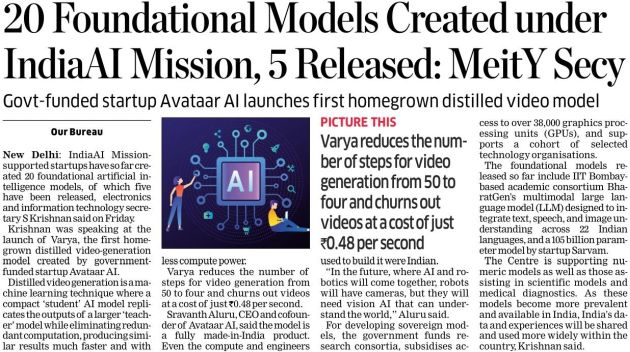
Good news is India has already kicked off foundational research, and the results are visible for all to see: IndiaAI Mission-supported startups have already created 20 foundational AI models, out of which five have been released (Source: MeitY). See exhibit below.
India’s biggest opportunity over the next decade may lie not in building the world’s most capable foundation model, but in becoming the world’s preferred partner for deploying AI at scale – integrating, customizing, fine-tuning, securing, and operating AI solutions across every industry.
This chimes with the playbook recommended by Vinod Dham, Adviser, India Semiconductor Mission. In his op-ed entitled AIm To Become Rollout Champs in Economic Times, the man who is often called the “Father of Pentium” writes:
India can become the world’s AI deployment hub by leveraging its software engineering workforce and enterprise IT experience. Enterprises will come to India to reinvent their businesses with AI integration and transformation consulting. This opportunity encompasses AI operations, cybersecurity, governance, and managed AI services.
This opportunity is far larger than many critics appreciate: For every $1 spent on AI software, companies are expected to spend $14 on AI Services (Source).
The Indian IT industry has hit $300 billion in annual revenues based on 1:3 ratio of license-to-services for ERP, CRM and other enterprise applications. Just imagine the growth opportunity unlocked by the 1:14 ratio in AI.
While on the subject, I’m disappointed that nobody seems to be talking about the 5-20 foundational LLMs that Indian starups have already built. Despite holding a government position, even Vinod Dham makes no reference to government data in his op-ed and pretends as though India has made no investment in frontier AI research. Well, these 5-20 LLMs didn’t fall from trees. Sarvam AI and other Indian foundational LLMs may not be in the league of OpenAI, Anthropic or Kimi but they’re not zero either. (If somebody thinks they are zero, they need to explain why they believe anything better will come out of more frontier research, which is what they’re exhorting India to do.)
I attribute the lack of buzz around these 5-20 LLMs to India’s perennial lack of investments in marketing. No country went from 0 to 10 without shouting about the achievements at the intermediate 1, 5, and 9 levels from the rooftop.
India won’t either. If Indian AI startups think “If you build, they will come”, they’re naive. Despite building one of the most pathbreaking products of all times, OpenAI didn’t believe in that notion – instead it spent 42% of its revenue on marketing to get where it is.
OpenAI Financials:
Revenue: $13.07B
Sales & Marketing Spend: $5.75B ~ 42% of Revenue. H/T @TheInformation via SEC IPO Prospectus.
Exhibit Z: Even one of the best products in the history of tech does not sell by itself, it needs marketing.— SKR (@s_ketharaman) July 31, 2026
Indian AI startups should plan to invest similar amounts in marketing, and go ye and forth and blow their trumpet about the foundational models they’ve already released.