People started complaining about the decline in quality of Google Search around a decade ago. Accordingly, many pundits predicted the demise of Google Search in the then near future. But, for reasons I speculated in my blog post entitled The End Of Google Search Is Not Nigh, it did not happen.
Then came ChatGPT at the end of 2022.
Before Google launched its web search product in 1998, I used to use Alta Vista, Lycos and other web search engines. In fact, I was a beneficiary of Search Engine Optimization even before Google was a thing! (see footnote 1). Alta Vista and Lycos took in a search query and outputed a series of links to websites that featured the keyword in the query. I was not thrilled with them since they made me do all the heavy lifting.
When Google launched and became an overnight success, I thought it gave an answer in response to a question (see footnote 2). But, alas no, Google also did what the incumbent search engines did, except faster and better (though not cheaper because all the search engines were free).
Since then, I’ve been craving for a search engine that gave answers instead of links.

I had to wait for 24 years for my wish to be fulfilled.
Launched in 2022, ChatGPT did exactly what I was expecting from web search. Not surprisingly, I took to it like fish to water. I found myself heading to ChatGPT more often than Google Search. Over time, many others reported the same behavior.
Predictions of the death of Google Search reached a new crescendo in the last couple of years.
Still Google Search has not died. On the contrary, Google is still 210x bigger than ChatGPT in search. Alphabet Inc., the holding company of Google, recently posted one of its best quarters on the back of robust growth in its search advertising business. The company’s stock price has doubled since April.
What gives? How is Google Search able to hold its own despite the onslaught of ChatGPT, Perplexity and other AI tools that have a far better search experience??
In this post, I’ll try and answer that question.
In my 2018 blog post, I’d enumerated a few factors that made folks wonder if the end of Google Search was nigh. Let me examine the impact of ChatGPT and other AI tools against those factors.
1. Given that the first result of most knowledge search is the Wiki entry for that term, I’ve always wondered why people don’t go directly to Wikipedia.
Now, people are not only bypassing Wikipedia but many of them are also skipping Google Search itself and going to ChatGPT.
2. I can’t remember the last time I went to Google to search for anything I bought.
When I bought things in the past, I used to spend hours researching comparisons and reviews on Google Search, Amazon Search, PriceGrabber and other websites.
I’ve totally stopped doing that now. I exclusively use ChatGPT as Buyers Guide.
To take an example, when I bought a smartphone recently, I simply entered my choice of brand, minimum specs and maximum budget into ChatGPT. I got two recommendations. I went ahead with one of them. I spend less than 15 minutes on deciding what to buy.
It’s not only me. The following exhibit shows the use of ChatGPT to decide which espresso machine to buy.
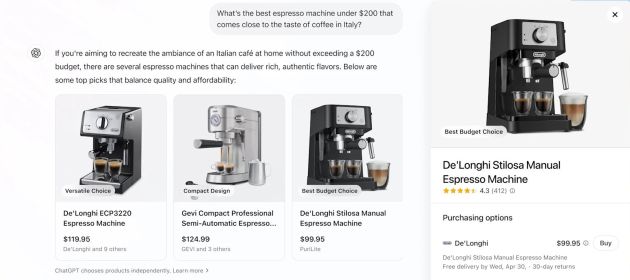
Then there are people who first use ChatGPT as a buyer’s guide and then as a user guide. In FORTUNE magazine’s Eye on AI newsletter, Sharon Goldman describes how she used ChatGPT as a personal stylist:
Last week, I received a subscription box from Short Story, a Stitch Fix-like service for petites. When I couldn’t figure out how to style the six items I received, I turned to ChatGPT. Explaining my predicament, I got very specific, including my height, weight, and age. “Could I wear the black Souri blazer I got with the Brynn contrast border wrap skirt?” I asked. Not only did ChatGPT reply in the affirmative and offer styling tips, it followed up by asking, “Would you like me to pull some top options that would work with this combo?” When I said yes, it served up links to several options from specific brands.
Going by these examples of people increasingly heading to ChatGPT instead of Google Search, Google’s search volumes should have nosedived by now.
But they have not. The volume of Google Search queries per year has gone up from 2 trillion in 2016 to 5 trillion+ in 2024 (11% CAGR).
# of Google Search queries per year:
– 2016: 2T+
– 2024: 5T+
– CAGR: 10.71%
People have been whispering since 2018 and shouting since 2022 about the end of Google Search but it has not yet happened.https://t.co/CJ56BIBu7n.
ChatGPT. genAI.— SKR (@s_ketharaman) April 24, 2025
As we’ll see in a bit, using ChatGPT as a buyer’s guide is still a niche activity.
3. People continue to use Google to search for concepts, phrases, lyrics and other forms of “knowledge”.
Lately they’re using ChatGPT for knowledge. Per Google executive Sissie Hsiao, ChatGPT has drawn away some search queries from Google, but they’re primarily “homework and math” queries that don’t generate much ad revenue. “So far we have not seen cannibalization of commercial queries or queries with commercial intent”, said Hsiao in an interview with The Information ($).
That shows that the use of ChatGPT as buyer’s guide has not yet gone mainstream. According to Search Engine Land, ChatGPT handles 66 million search-like prompts daily as against Google, which does 14 billion searches per day.
But, even if ChatGPT’s use as buyer’s guide does go mainstream, Google can counter the trend by inducing people to use its Gemini-powered AI Overviews to serve this use case. Philipp Schindler, Chief Business Officer of Google, recently told Martin Peers, writer of The Briefing newsletter from The Information, that commercial queries had increased thanks to AI Overviews. The Register recently reported that Google has started placing ads directly above and within AI Overviews box. Although I haven’t seen such ads, they get higher clickthrough rates than the normal Google Ads placed outside AI Overviews, according to Google CEO Sundar Pichai.
4. Website search is growing from all kinds of users.
I’m sure this is still true even though some people have started reporting the use of Perplexity AI to carry out web searches.
5. There are a few dark clouds on the horizon for Google Search.
Mobile ads prices went up gradually. Voice search and blockchain ad killers did not gather much traction. None of these dark clouds I foresaw seven years ago have mattered much so far.
Needless to say, past performance is no guarantee of future results.
But some experts – presumably Google Search Maxis! – argue that, even if Google Search query volumes decline, Google’s advertising revvenues will not decline by as much. That’s because most advertisers would find it easier to stick with Google than to manage ad buys on numerous other services. The situation is reminiscent of how the broadcast TV industry retained a huge share of TV advertising even as its viewership shrank, because it remained the best way to reach a large number of people (Source: Advertising analyst Brian Wieser, of Madison and Wall).
But they also admit that, after proving resilient for a decade or two since the Internet went mainstream, broadcast TV and newspapers finally did start losing advertisers. If ChatGPT, Perplexity et al grab a big chunk of search traffic, Google Search volumes – and ad revenues – will eventually decline.
 But no one can tell the date of eventually. There are some cases where that happened in a few years and other cases where it did not happen even after decades.
I was thinking of Salesforce v. Siebel as an example for the former but ChatGPT disagrees and suggests Netflix v. Blockbuster instead.
For the latter, I can think of Amazon, Fintech and Uber as good examples: Despite being around for many decades, Amazon has not killed brick-and-mortar stores, fintech has not killed banks, and Uber has not killed yellow cabs.
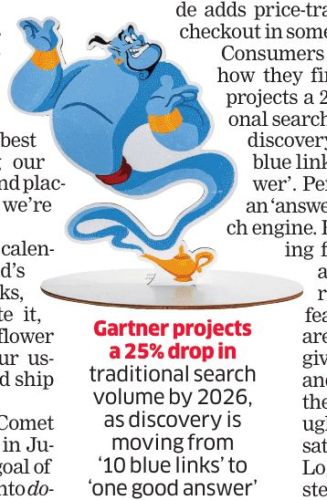
Gartner projects a 25% drop in traditional search volume by 2026, as discovery is moving from “10 blue links to one good answer”. Well, people have been wishing for discovery to move from links to answers for 24 years. Wish and fulfillment are two different things. Let’s see how this prediction pans out.
Someone once said that the only way to outflank Google is not by building a better search engine but by making search irrelevant. genAI has at least proved that part. Until ChatGPT came along, nobody even daydreamed about the death of Google Search.
FOOTNOTE(S):
- I was running marketing for an ERP company at the time. One of our customers, a leading petroleum refinery, had just gone live on our software. I’d written a case study of that implementation and published it on our company’s website. Somebody in Kenya was planning to buy an ERP for a Gulf African petroleum refinery and typed “ERP for Petroleum Refinery” in the Lycos search box and our success story popped up first on the SERP. They clicked through the link, visited our website and reached out to us. Long story short, we got our first customer in Africa without any presence in the continent.
- Apparently, Google also thought the same! In 2000, Larry Page said that, in the ultimate version of Google, the computer “understood what you needed, and gave you exactly that thing”. H/T @ByrneHobart, The Diff newsletter dated 3 November 2025.