Today’s Economic Times published my letter on H-1B and the controversy over surplus or scarcity of STEM talent in the USA.

It was in response to the following article on this subject two days ago.

The published version of my letter is a highly condensed version of my original letter. As a result, it’s quite cryptic (even to me!).
Therefore, I thought of reproducing the full text of my letter to convey my exact thoughts.
Here goes:
From: Ketharaman Swaminathan
To: editet@timesgroup.com
Subject: To H-1B or Not H-1B
Dear Editor of Economic Times:
This has reference to the aforementioned article by Neeraj Kaushal in today’s edition of Economic Times.
Work done by most programmers renders the jobs of non-programmers – not programmers – redundant e.g. programmer of a financial accounting system renders the job of accountants – not programmers – redundant. Very few programmers work in advanced areas of programming like development of automation platforms that render a programmer’s job redundant. Accordingly, I’m afraid, the author’s friend John Fitz is an outlier and is not representative of the overall STEM population.
In my three decades of experience of working in the IT industry, I’ve realized that technological obsolescence is exaggerated. American enterprises surely want to sunset their legacy systems and transform their IT landscape to latest technologies. But that’s easier said than done. Cost and risk factors preclude a rip-and-replace approach. While not many new systems have been developed on legacy technologies in the last 15-20 years, old systems are still around. According to various estimates, nearly 75% of America’s GDP is still processed on mainframe systems. Those systems need to be maintained. That requires STEM talent in legacy technologies.
In short, STEM talent is required in both new and old technologies.
But the requirement is not uniform between onsite and offshore locations.
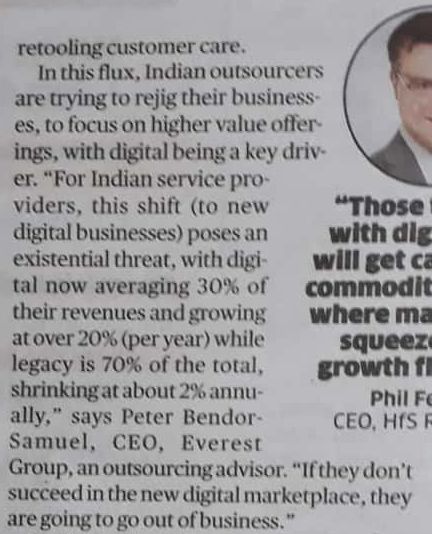 Maintenance tends to be a 24*7*365 activity. This makes it challenging for service providers to render this service from a single location – after all, the sun sets everywhere daily and people need to sleep. “Follow the sun” – the offshore delivery model that leverages the fact that it’s day in one place when it’s night in another – provides an ideal method of rendering maintenance services.
As a result, maintenance tends to get outsourced to offshore locations like India (the lower offshore cost helps sweeten the move!). Since maintenance tends to be of legacy systems and is largely carried out from offshore, offshore STEM talent needs legacy skills. Not surprisingly, 70% of the Indian IT industry’s revenues come from legacy technologies.
On the other hand, development work is typically carried out closer to the customer site and generally during business hours. Since it happens mainly in modern technologies, onsite STEM talent requires digital skills. As long people like John Fritz get retrained in modern technologies, there’d be a good supply of local STEM talent onsite.
However, that doesn’t mean they’ll automatically get jobs.
That’s because American companies can access an alternative source of talent in USA, namely, Indian programmers on H-1B. As long as there’s a free flow of H-1B visas, there will be no scarcity of onsite Indian programmers, who are typically available at an annual salary of $60K (as against $125K for local STEM talent).
The commercial tension between local talent and “imported” H-1B talent is clear. The question of whether there’s a scarcity or surplus of local STEM talent in the USA revolves around money.
There’s a shortage of local STEM talent in USA at $60K but there’s no shortage at $125K.
That is the bottomline. The author’s attempt to address this issue based on type and generation of technology is flawed.

Thanks and Regards.
KETHARAMAN SWAMINATHAN
Pune, INDIA