According to a popular joke on X fka Twitter, the greatest fiction is written in Excel, not Word.
This is a dig at projections of Total Addressable Market made by startups in their fundraising pitch decks. And also by McKinsey, Gartner and other leading consulting and research analyst firms in their research reports.
I’ve started doing it. But I’ll need to wait 8 years to know the result. #McKinsey #Metaverse pic.twitter.com/XdKnRlfnXV
— SKR (@s_ketharaman) November 4, 2022
There’s some truth to this. Startups are mainly funded by VC. Unlike traditional forms of capital like equity and bank loans, venture capital indexes on home runs from very few portfolio companies, and backs only businesses with huge TAM (at least one billion dollars when I last checked). As they say, what matters in VC is not what percentage of your portcos become unicorns but how many unicorns are there in your portfolio.
To appeal to VCs, there is a tendency among startup founders to be bullish about TAM.
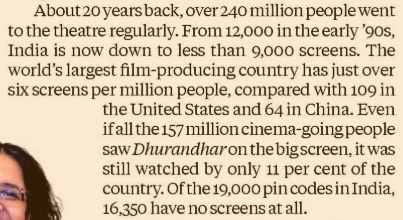 The common critique of this approach is that treating India as a market of 1.4 billion consumers is a fiction. According to the critics, the real TAM for most products/ services is less than 150 million. The critique is grounded on the argument that India has a low per capita income ($2800), so a vast majority of Indians do not have the purchasing power to belong to the TAM of most products / services.
This argument sounds sensible at first blush but it misses a key point:
TAM is a statement of purpose, not low hanging fruit available for plucking on Day One.
No startup claims to achieve its TAM on Day 1.
By the time a startup projects to get there, many things happen in the world around it.
1. Technology advances
With the current state of technology, the startup is able to target only a subset of the full TAM. But, as technology advances, the startup can target the entire TAM.
Sequoia partner Julien Beck offers an excellent example of this in the context of AI in his viral essay entitled Services: The New Software.
The playbook: companies should start with the outsourced, intelligence-heavy task. Nail distribution. Expand toward the insourced, judgement-heavy work as the AI compounds. The outsourced task is the wedge. The insourced work is the long-term TAM.
2. Economy expands
Over time economy grows. Trickle down effect takes hold. Poor become less poor and their disposable income raises. Therefore they can afford things they could not before.
Ten years ago, my maid servant – er, household help – was not in the TAM of smartphone. Today all ABCDs (Ayah Bai Cook Driver) in my housing complex have a smartphone.
Anybody who went by smartphone’s TAM 10 years ago would have drastically underestimated the eventual market for the device.
3. Marketing
Marketing creates aspiration and raises people’s desire. Middle class raises its spend on discretionary goods.
A good example of this is the explosion in credit card market – the business has grown by 300% in the last five years.
“Capitalism requires the construction of needs that do not naturally occur” ~ Martin Kihn, Gartner.
Advertising constructs needs by telling people “The Way To Be A Better Person Is To Have Better Things” ~ https://t.co/WOYSVK6sgV via @RegaJha .
— SKR (@s_ketharaman) March 3, 2020
4. Deflation
Prices fall in future. This increases affordability.
According to what is popularly called the “Chart of the Century“, goods produced by many industries that are free from government regulation have become cheaper during the two decades e.g. TVs, toys, mobile data, clothing, furnishings.
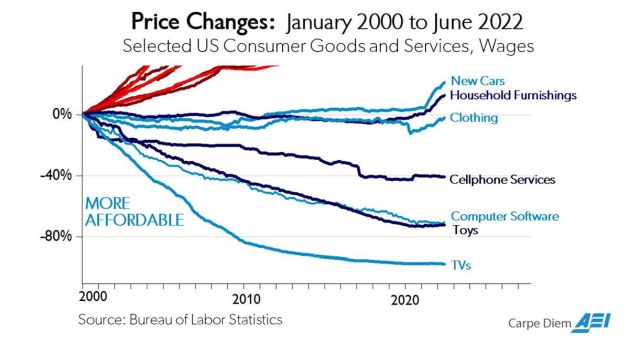
I can totally relate to this from my personal experience. My working lunch that cost INR 90 in 1988 costs INR 450 now (4.3% CAGR). The typical Louis Philippe shirt I used to buy for INR 1200 in 1988 costs INR 2500 now (1.95% CAGR). Both of these have risen by less than inflation during this 38 year period.
5. Jevon’s Paradox
According to Jevon’s Paradox, “We’ll spend more on what gets more productive”.
This is an extreme case of explosion in TAM due to fall in price, and has several examples viz. transistor.
Today we all know Moore’s Law, the best contemporary example of Jevons paradox. In 1965, a transistor cost roughly $1. Today it costs a fraction of a millionth of a cent. This extraordinary collapse in computing costs – a billionfold improvement – did not lead to modest, proportional increases in computer use. It triggered an explosion of applications that would have been unthinkable at earlier price points. At $1 per transistor, computers made sense for military calculations and corporate payroll. At a thousandth of a cent, they made sense for word processing and databases. At a millionth of a cent, they made sense in thermostats and greeting cards. At a billionth of a cent, we embed them in disposable shipping tags that transmit their location once and are thrown away. The efficiency gains haven’t reduced our total computing consumption: they’ve made computing so cheap that we now use trillions times more of it. – Why AC is cheap, but AC repair is a luxury, a16z.
6. Credit
Finally, there’s the mother of all factors: Credit.
BNPL has expanded the TAM of consumer goods by many times. Mortgage has expanded the TAM of home buyers by 10X or more.
All of these factors boost the TAM for startups. Most of them require no specific action by startups (other than to spot them and position themselves in their slipstream).
Failure to consider these stimulants leads to hilarious underestimations of TAM like:
- UPI: An ex government official predicted that the TAM of UPI wouldn’t exceed 10 million users probably because there were fewer than 5M smartphones at the time. UPI now has 450 million users.
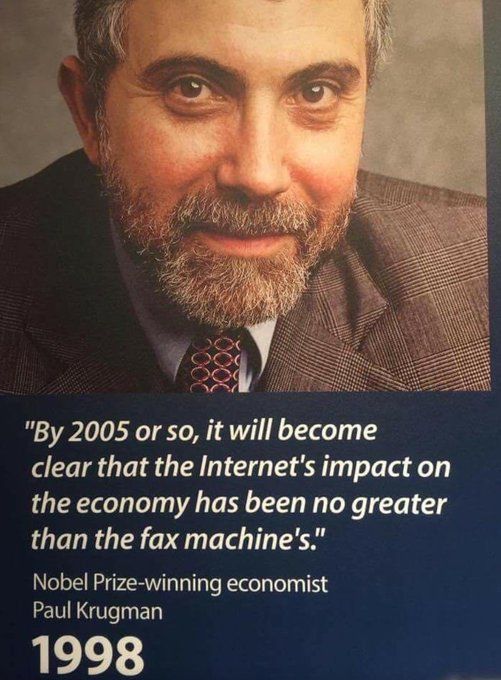
- Internet: An Economics Nobel Laureate once likened the Internet to fax machine and predicted that it wouldn’t have a TAM of more than 100 million. Enough said.
Another important thing is how the startup views TAM.
There’s an old story of a shoe manufacturer who sends two salesmen to a remote island to estimate the TAM for its shoes. One guy comes back saying there’s no market for shoes since everybody is barefoot. The other guy comes back saying there’s a huge market for shoes since everybody is barefoot.
The first guy treated barefoot as the end state. The second guy treated barefoot as the start state. So they projected wildly different TAMs.
That said, not all factors need to be TAM-accretive. Some of them could also depress TAM e.g.
- The TAM for business travel fell due to COVID-imposed lockdowns for a couple of years (before it started ticking back up due to “revenge travel”).
- According to SAASpocalypse Maxis, AI will kill software and slash the TAM for SAAS.
The point is, whether it rises or falls with time, TAM is not fiction. It’s prediction. As the famous baseball player Yogi Berra once said, “It’s hard to make predictions, especially about the future”!
Some startups achieve the projected TAM. Some startups don’t. That’s how business works. There’s no need for conspiracy theories.