(This post is a slightly edited version of my answer to the above Quora question.)
Question: Has UPI Disrupted Credit Card?
Short Answer: No. UPI has boosted credit card.
Long Answer:
According to the theory of Disruptive Innovation by Late Professor Clayton M. Christensen of Harvard Business School, many giant incumbents face The Innovator’s Dilemma and see their business get steadily eroded by (what I call) CHILL new entrants.
To qualify as Disruptor, a product must be CHILL:
CH: Cheap.
I: Inferior quality.
LL: Low end target market.Ergo:
* Uber did not disrupt yellow cab
* iPhone did not disrupt smartphone / Nokia / BlackBerry— SKR (@s_ketharaman) May 31, 2021
When UPI was launched in 2016, Credit Card was the Incumbent in digital payments in India:
- It was around for 40 years.
- It levied a fee on merchants aka Merchant Discount Rate (MDR). Some credit cards also had membership fees. So credit card was not cheap.
- Although close to one billion Indians had a bank account, there were only 40 million credit cards in circulation in a population of 1.4 billion people. Banks acquired only medium and large merchants for credit card acceptance. Small merchants were ignored due to their higher Acquirer Risk profile. So credit card was a high-end product.
(All of those attributes of credit card continue to be true even today.)
UPI fulfilled the criteria of a CHILL Entrant:
- Cheap: UPI was free for both consumers and merchants. So, it was cheaper than cheap.
- Inferior: UPI did not provide rewards, deferred payment, fraud protection, and other benefits of credit card.
- Low End: UPI was a matter of right. Any consumer and merchant with a bank account had be provided UPI access by their respective bank.
(All of those attributes of UPI continue to be true even today.)
Accordingly, UPI had all the makings of a Wannabe Disruptor.
In the early days of UPI, many people expected UPI to disrupt Credit Card.
At the height of Kool Aid about UPI in 2016-2017, a government honcho predicted that UPI would kill POS terminals (aka credit card) by 2020.
Nothing like that happened. Instead the count of POS tripled during the period from 2017 to 2020.
At the peak of re/demonetization, a govt honcho predicted that POS machine will be dead in India in 3 years. 2 years later, the count of POS has shot up from 1.5M to 4.25M. This is going to be the most harebrained prediction of all times! https://t.co/aDtFMsXQwr
— GTM360 (@GTM360) November 11, 2019
(I rate this as one of the most harebrained predictions of all times.)
Cue to the present day.
As I highlighted in my blog post entitled Unpacking The Credit Card Boom In India, credit card business has grown by 3X in the last five years in India.
So it’s evident that UPI has not disrupted credit card.
I advance five reasons as to why.
1. Disruption shisruption
Whenever a new entrant gains traction, most people think the incumbent will die.
Zero-sum thinking of this nature misses that UPI and Credit Card can both grow together in developing markets like India where:
- GDP growth is high – India is the fastest growing trillion dollar economy in the world.
- Digital payments has a low penetration rate – 5% when UPI was launched, and 40% today.
For that matter, multiple methods of payments can grow together even in markets with one of the above two attributes e.g. USA (90% digital payments penetration but relatively high GDP growth rate) but not in those with neither of the two attributes e.g. Germany (over 50% digital payments penetration but moribund economy).
2. Greater visibility of digital payments
When you pay with UPI, you’re spending your own money, so UPI is available as a matter of right. In other words, it’s a democratic product. On the other hand, when you pay with credit card, you’re using your bank’s money. In a low income country, credit card is an elite product. Just as there are many more Maruti 800s than BMWs, there are many more UPI users than credit card holders in India.
Before UPI went mainstream, the only way to pay digitally was with credit card. Since there weren’t too many credit cards around, a vast majority of people paid with cash. So, to the common man / woman in India aka J6P, retail payments was synonymous with cash.
But, after UPI went mainstream, J6P started seeing consumers paying digitally all around them.
i think you’re missing that majority of india paid with cash only.
suddenly paying digitally with additional MDR charges had a negative effect as compared to paying with cards with MDR (which is prevalent in ~ 5% population).
most were new to this. even i was.
— DND (@maybejha) October 28, 2025
The ubiquity of UPI propelled the visibility of the basic notion of digital payments to a different orbit. People started appreciating that there were other digital payment methods like credit card that offered benefits like rewards, deferred payment, airport lounge access, etc., and applied for credit card at scale.
This may not have happened if UPI hadn’t raised the visibility of digital payments to the next level (see footnote 1).
3. Better fraud protection
I’ve replaced some of my cash and NEFT payments with UPI but I’ve not replaced any of my credit card payments with it. Therefore, UPI has not dented my credit card usage.
That said, some credit cardholders found UPI more frictionless and switched some of their payments to UPI.
But, intimidated by the growing incidents of scam in UPI, some of them have switched back to credit card since it offers better fraud protection. (Besides, contactless / tap-and-go and Visa Direct have reduced friction in credit card payments. Personally, I find it more convenient to use contactless credit card than UPI.)
4. Hunger for revenues
After Reg ZeroMDR came into effect from 1 January 2020, banks don’t make any money on UPI payments. On the other hand, they earn 2–3% interchange / MDR revenue on credit card. Hungry for revenues, many banks have gone into an overdrive to issue new credit cards.
In parallel, banks and fintechs like PayTM and Walmart PhonePe have ramped up acquiring by signing up more merchants for credit card acceptance.
Their aggressive marketing of credit card resonated well with the growing preference of creditworthy consumers for credit card, which led to an explosion in credit card business.
5. UPI was never meant to disrupt Credit Card
According to the Disruptive Innovation playbook, the entrant gains a foothold by being CHILL but, over time, raises prices, generates surplus cash, and plows it back to improve the product features so that it can attract the incumbent’s high end customer segment on the way to disrupting it.
I once half-jokingly predicted that any digital payment method that gave 2X the rewards of credit card and charged 0.5X the MDR of credit card would disrupt credit card.
UPI went halfway: At its inception, UPI charged 0.6% MDR, which is less than half of 2-3% MDR of credit card. Once Reg ZeroMDR came into effect on 1 January 2020, MDR was slashed to zero.
But only halfway: UPI never offered rewards.
While UPI has undergone several upgrades in the last decade since launch, none of them truly replicate the benefits of credit card (see footnote 2). Lack of rewards is a commercial issue; absence of fraud protection is a technocommercial constraint; and the inability to permit deferred payments is a combination of business and core banking system (CBS) architecture challenges (see footnote 3).
Despite incessant entreaties from banks, PSPs (payments solutions providers), NPCI (National Payments Corporation of India) and RBI (Reserve Bank of India), the government has still not permitted the reintroduction of MDR for UPI. This suggests that the government always envisaged UPI to be a public good.
We should also remember that NPCI also operates RuPay credit card. It’s quite possible that, like me, NPCI sees a more feasible path for disruption via RuPay credit card. If so, it makes more sense to use RuPay to drive disruption instead of UPI to disrupt credit card.
I became even more convinced of this reasoning after reading NPCI’s acknowledgment of the explosive growth of credit card in its circular dated 4 October 2022.
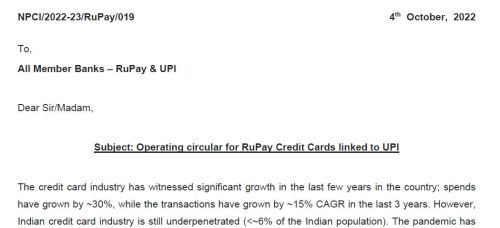
When was the last time you heard a wannabe disruptor admitting that the incumbent has “witnessed significant growth”? I thought so, too.
On a related note, over 100 countries showed interest in UPI in ca. 2016-2017. Subsequently, people also made a big deal of Google pitching UPI to the Federal Reserve Board for the then planned account-to-account real time payment system in USA.
Five years ago, I argued that UPI lacked value proposition outside India in Don’t Go Global Without Cracking The Value Proposition For Foreign Markets.
My blog post has aged well. A decade later, only three countries in the world have adopted UPI as their domestic A2A RTP viz. Nepal, Namibia, and Peru. Fed rejected Google’s offer of UPI and built a homegrown system called FedNow.
While on this topic, there’s a lot of talk of people in Singapore, UK, etc. being able to make payments via UPI. They’re not. In these cases, the UK resident sending money to someone in India uses her domestic payment system (FPS, not UPI) to initiate the payment, a global network like Nexus handles the UK to India leg, and only the India leg of the payment is fulfilled by UPI. To be clear, UPI is not used as the domestic payment system in UK (or Singapore). Projecting this as “UPI has gone Global” is like claiming that NH84 has gone global since a UK national can drive on this national highway from Delhi to Mumbai.
At last MSM calls BS of “UPI Goes Global” fake narrative. It does not mean UPI will replace digital payments in USA etc. It only means UPI has tied up with domestic payments scheme to enable Indians to make A2A payments between foreign country and India. pic.twitter.com/ZoDPP5fDPR
— SKR (@s_ketharaman) December 5, 2023
In short, UPI has not disrupted credit card in India or outside India (see footnote 4).
And that’s not a bad thing at all. It shows that a product can succeed by expanding the market without having to engage in a zero-sum game with its competitors.
FOOTNOTE(S):
- A crude analogy would be the impact of Starbucks in India. Before the global coffee retail leader entered the country, a cup of coffee sold for INR 10-75. Starbucks proved that there was a sustained and large enough market for coffee at INR 250 per cup in India. Its market development was followed by a big surge of competitors that set shop with prices in the $2.5-$3.5 range. These included domestic chains like Third Wave Coffee and Blue Tokai and international ones like Tim Hortons and Prêt à Manger. Even streetside coffee sellers have doubled their prices after seeing the acceptance of high priced coffee in the market.
- I’m excluding the RuPay via UPI upgrade since it doesn’t make any sense to talk of UPI disrupting credit card when it actually supports a credit card.
- I’m excluding the UPI Credit Line upgrade since it has reportedly flopped.
- This blog post is a record of what happened in the 10 years after UPI was launched. Nothing in it should be taken as a prediction of the future. Amidst Trump Tariffs and other geopolitical issues facing the country, if Visa and MasterCard suddenly get banned, UPI would end up disrupting the global credit card network giants by default.