“When President Trump announced sweeping tariffs in April, economists predicted surging inflation and raised the odds of a recession. Those worries now seem overblown.” ~ How the U.S. Economy Has Defied Doomsday Predictions on Tariffs, Wall Street Journal.
I’d predicted this in my previous blog posts on Trump Tariffs (see RELATED READING at the end).
A few readers reached out to me with the following questions:
- Why would American Importers absorb the burden of Trump Tariffs?
- Why would Foreign Exporters absorb the burden Trump Tariffs?
- How can Foreign Exporters pay Trump Tariffs?
All of these questions show a keen understanding of the economic theory on tariffs.
In this post, I’ll try and answer them from the perspective of a practical business.
Here’s a schematic of cross border trade between USA and a foreign country e.g. India.
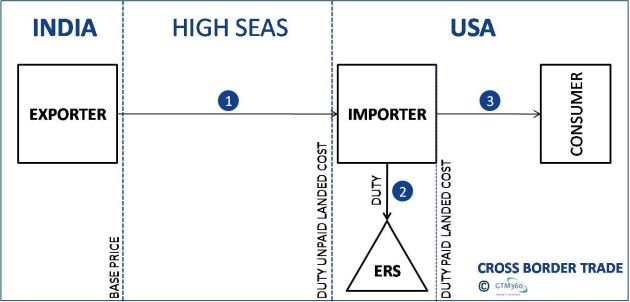
The four key parties involved in this trade are:
- Foreign Exporter: The company in India that exports its goods to USA.
- American Importer: The company in USA that imports the goods from India.
- American Consumer: The individual or business in USA that buys the goods from the American Importer.
- External Revenue Service (ERS): The US federal agency that collects Trump Tariffs from American Importers.
(see footnote 1)
The three major steps in crossborder trade are as follows:
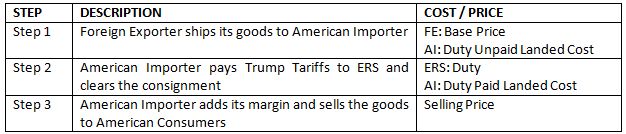
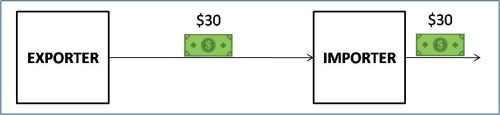
Before Trump Tariffs came into effect, if the Base Price of the Foreign Exporter is $30, the Landed Cost for the American Importer would be $30 (see footnote 2).
After Trump Tariffs (of, say, 25%) comes into effect, economists would predict the following situation:
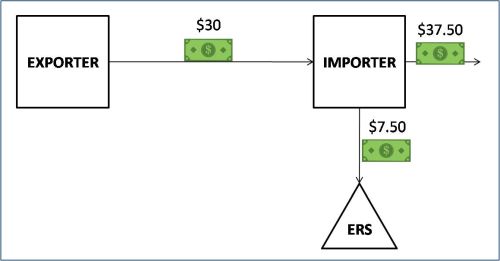
They’d continue to treat the Base Price as $30. Accordingly, the American Importer’s Duty Unpaid Landed Cost would be $30, American Importer would pay $7.50 Trump Tariffs to ERS, and the Duty Paid Landed Cost would be $37.50. They’d also predict that the American Importer would pass on the additional $7.50 to American Consumers, ergo predict inflation.
But real world business rarely works like that, which is why the US economy has defied doomsday predictions on Trump Tariffs.
As we saw in Trump Tariffs: Who Is Paying How Much?, in actual practice, the bulk of the $7.50 is actually being borne by American Importers and Foreign Exporters and not being passed on to American Consumers.
Which brings us to my answers to the questions asked by my readers.
1. Why are American Importers absorbing the burden of Trump Tariffs?
Per economics, tariffs is a tax on consumption, consumers should be paying it, so it’s reasonable to wonder why American Importers would absorb it instead of passing it on to American Consumers. In business, there are at least two reasons for that:
- Many products are highly price-elastic to demand. That is, if the price increases even slightly, the demand will fall sharply. To prevent loss of market, American Importers have a strong incentive to keep the prices unchanged as far as possible.
- Donald Trump has publicly scolded large retailers like Walmart and Amazon for increasing prices. To avoid getting into the bad books of POTUS, many retailers try to absorb the burden of Trump Tariffs instead of passing it on to American Consumers.
In his The Diff newsletter dated 3 November 2025, Byrne Hobart has an interesting take on the second point.
In its article titled How the U.S. Economy Has Defied Doomsday Predictions on Tariffs, WSJ notes that tariffs haven’t had a big impact on inflation … because companies are absorbing the cost. And one of their explanations for that is that post-pandemic, margins went up for just about everyone. Back in early 2023, The Diff asked how permanent the post-pandemic margin reset was, and noted that one of the forces that pushes it down is politics: If revenue is rising faster than costs, and labor is the biggest component of costs, then workers will complain that they aren’t participating in economic growth. That would normally lead to a more left-populist swing among voters, but a right-populist got elected, made a policy decision whose economic cost could be faced by either companies or consumers, and let those companies make the call that it was politically safer for them to lose a point or two of margin than to be part of the political narrative.
2. Why are Foreign Exporters absorbing the burden of Trump Tariffs?
Per economics, tariffs is a tax in the importing country, so it’s reasonable to wonder why Foreign Exporters would absorb it.
The answer to that lies in how B2B marketing works in real life.
Under pressure to absorb the burden of Trump Tariffs due to reasons given in #1 above, American Importers will reach out to their Foreign Exporters with a “request for adjustment” of their base price such that their DPLC after Trump Tariffs remains unchanged from their DULC before Trump Tariffs i.e. $30. In my previous posts, I’ve given many examples of American Importers doing this ever since Trump Tariffs was announced e.g. Walmart.
When contacted by their customers, suppliers can say YES or NO.
If Foreign Exporters say NO,
Duty Paid Landed Cost = $30 + $7.5 = $37.50 (as shown in Exhibit 4 above).
This is the simplistic situation envisaged by sinecure economists.
But this is also the least likely situation in real life. Because, if their existing suppliers decline their request to reduce base prices, American Importers can switch their sourcing to a different supplier in another nation that’s subject to lower Trump Tariffs, and Foreign Exporters will lose their largest – and often the most lucrative – market (see footnote 3).
Even if the new supplier from the new country has a higher base price than the incumbent supplier, it might have the same – or even lower – DPLC.
Let me illustrate this with an example:
Before Trump Tariffs:
- Base Price of Foreign Exporter 1 from Country 1: $100.
- Base Price of Foreign Exporter 2 from Country 2: $110.
- DULC for Foreign Exporter 1: $100.
- DULC for Foreign Exporter 2: $110.
Now, let’s say, Country 1 is hit with 25% Trump Tariffs and Country 2 is hit with 10% Trump Tariffs. While there’s no change in the DULC figures, the DPLCs will be different.
After Trump Tariffs:
- DPLC for Foreign Exporter 1: $100 + 0.25*$100 = $125.
- DPLC for Foreign Exporter 2: $110 + 0.1*$110 = $121.
As you can see, while Foreign Exporter 2 ($110) is costlier than Foreign Exporter 1 ($100) before paying Trump Tariffs, Foreign Exporter 2 ($121) is cheaper than Foreign Exporter 1 ($125) after paying Trump Tariffs.
Ergo, if Foreign Exporter 1 says no, it could lose the business to Foreign Exporter 2.
To avoid that eventuality, Foreign Exporter 1 i.e. the incumbent Foreign Exporter may say YES, and reduce its Base Price to $24 so that its DPLC for the American Importer will remain $30.
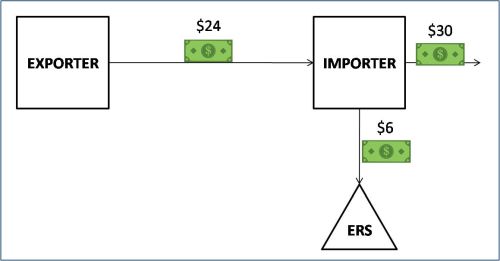
Obviously the Foreign Exporter cannot indefinitely absorb the burden of Trump Tariffs. The limit to which it can do so depends on its margins, among other factors.
Normal Margin
The Indian textiles industry has normal margins. USA is its largest and most lucrative market. It makes sense for Foreign Exporters in this industry to reduce their base prices by some extent to partially absorb the impact of Trump Tariffs.
As I pointed out in an earlier blog post:
I know my sales realization when I sell to USA versus other countries. Even after absorbing tariffs in the low teens, I’d make more money selling to USA than any other market in the world. So, as an exporter, I’d rather pay tariffs due on American importers than lose the lucrative American market.
According to the following Financial Express article, Foreign Exporters in the Indian textiles industry have offered 25% discount to retain their American customers.
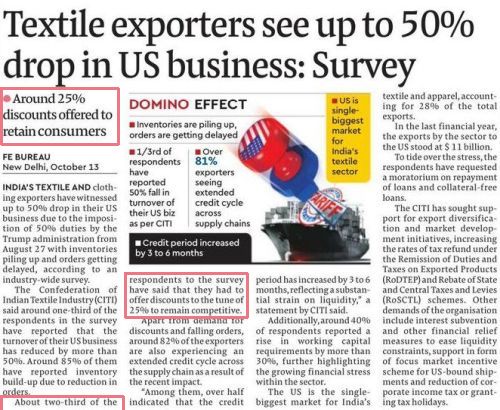
This totally rhymes with my prediction in my previous blog posts that the supply chain – i.e. Foreign Exporter plus American Importer – will absorb Trump Tariffs in the low teens or even as high as 25%.
High Margin
An industry that will go unnamed has high margins viz. $5 Cost and $30 Selling Price.
It’s currently not subject to Trump Tariffs. Suppose it’s hit with Trump Tariffs. Intuitively, it should be able to absorb more than 25% of the burden of the aforementioned textiles industry with normal margin.
Indeed it can.
I’ve simulated the impact of varying levels of Trump Tariffs from 25% upwards. Cf. following exhibit for the details.
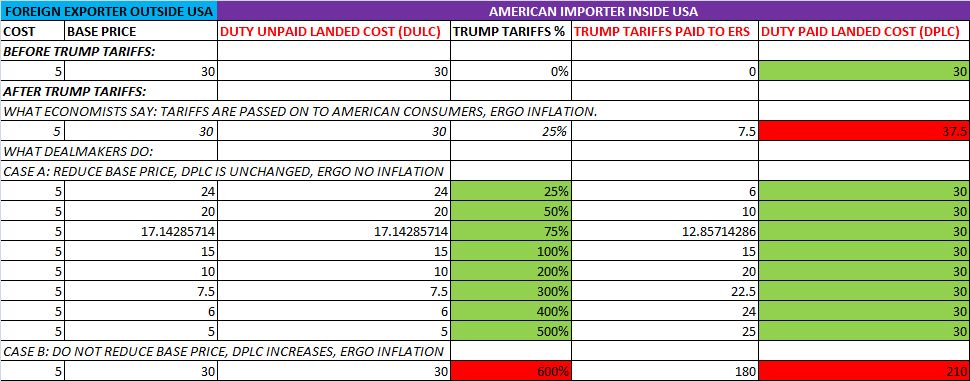
As you can see, Foreign Exporters in this industry should be able to absorb Trump Tariffs up to 500% without breaking a sweat (see footnote 5).
3. How can Foreign Exporters pay Trump Tariffs?
American Exporter wires Trump Tariffs to ERS before clearing the Foreign Exporter’s consignment, so the statement “Foreign Exporter pays Trump Tariffs” is not literally correct.
However, as we’ve seen above, Foreign Exporter gives a discount to offset the impact of Trump Tariffs such that the American Importer’s total landed cost after paying the tariffs is unchanged. So, the Foreign Exporter has effectively paid Trump Tariffs.
As we can see, the concept that consumers always pay tariffs is a simplistic academic notion. It does not reflect the real world of business, where importers and / exporters often absorb some or all of the tariffs.
As Economic Times says:
Producers and exporters have absorbed a considerable proportion of the tariffs, instead of passing it all to the US consumer. Many have swallowed up the tariff as a bitter pill to ensure they don’t lose their US market share to others. It is the cost of doing business with Trump’s US, they reckon.
In closing, Trump Tariffs has been ruled illegal by a US District Court and the verdict has been confirmed by Circuit Court of Appeals. The case is headed to the Supreme Court. However, ERS can continue to collect Trump Tariffs until the SCOTUS’ verdict is out. I find it a bit strange that a court of law can allow an illegal activity to continue. But I digress.
If SCOTUS confirms the previous courts’ verdict, Trump Tariffs will be reversed. If that happens, ERS might refund the tariffs already collected. Foreign Exporters who accommodated the adjustment requests of American Importers to reduce their base price to mitigate the impact of Trump Tariffs might want to put a clause in their contracts saying they should be made whole if ERS refunds Trump Tariffs to American Importers.
I cringed when I typed might and if instead of “will” and “when” in the last paragraph. After all, if SCOTUS outlaws Trump Tariffs, shouldn’t ERS be automatically ordered to refund the tariffs already collected? Apparently not. For reasons that I’ve not fully understood, there’s a nontrivial chance that tariffs already collected won’t be refunded even if Trump Tariffs is ruled illegal by SCOTUS. In fact, the crypto-based prediction market Polymarket puts the odds for that paradox as high as 75%.
A = SCOTUS rules “Trump Tariffs is Illegal”
B = SCOTUS rules “Trump Tariffs should be Refunded”.
p(A) = 0.49, p(B) = 0.12 (Polymarket).
Conditional probability of Refund given Illegal = p(Refund/Illegal) = p(B/A) = p(A/B)*p(B)/p(A) = 1*0.12/0.49 = 0.25 ~ 25%.— SKR (@s_ketharaman) September 9, 2025
RELATED READING:
- Trump Tariffs: Who Is Paying How Much?
- 10 Things They Didn’t Tell You About Trump Tariffs
- Dealmakers Trump Economists In Predicting The Impact Of Tariffs
- Trump Tariffs: 7 Reasons Consumers Won’t Pay The Price
- Globalization – Good or Bad?
FOOTNOTE(S):
- I’ve ignored the shipping company because it’s not material to the current context.
- Assuming freight is NIL. This assumption does not materially change the figures in the current context.
- Per economic theory, largest buyers extract the greatest discounts and pay the lowest prices. However, that’s not true for goods imported by USA. Contrary to common wisdom, USA pays the highest prices in the world for shrimps, textiles, and software despite being the largest market for them. Seems like purchasing power parity is a stronger determinant of prices across countries than cost-plus.
- I used the Excel What If Analysis Goal Seek feature to run this simulation. The non whole numbers 17.14285714 and 12.85714286 are the receipt!
- Whether they actually do so is a blog post for another day.