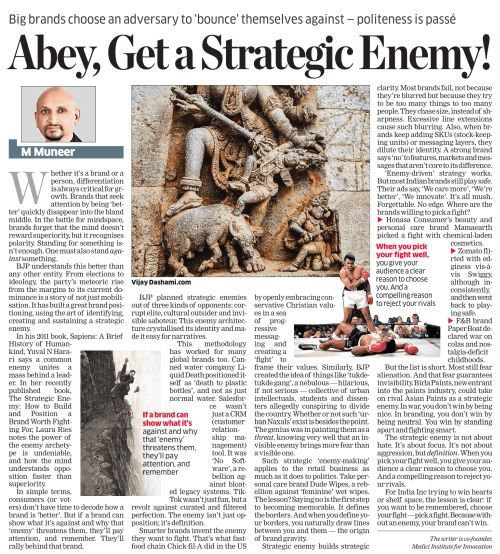
In his oped entitled Abey, Get a Strategic Enemy! in the Economic Times dated 2 October 2025, M Muneer proposes what I call the Strategic Enemy playbook to create revolutionary brands.
Strategic Enemy Playbook
Brands seeking improvement often disappear. Brand growth needs differentiation by enemy. The human mind recognizes opposition, not superiority. American brands Liquid Death and Salesforce employed it. So must Indian brands if they want to go global.
This is the most insightful article I’ve read on branding in recent times.
The author’s playbook rhymes with my personal experience and anecdata in many ways.
1. Software As The Enemy
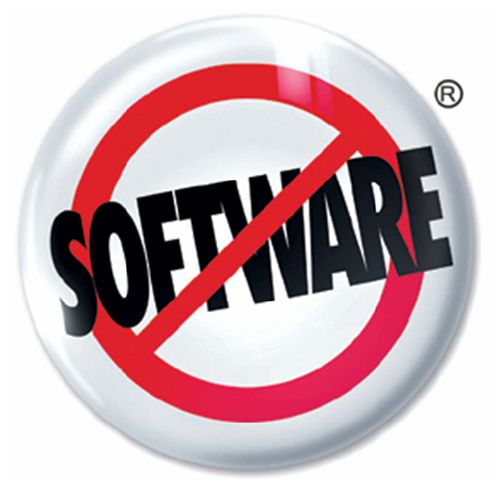 I was flabbergasted by the “No Software” tagline used by Salesforce when it launched its cloud CRM in the late 1990s. To a career software industry professional, Salesforce’s GTM messaging seemed misleading. Its CRM had as much software as did the CRM incumbents of the time, except that Salesforce CRM did not require any downloads or installs as it was deployed on cloud infrastructure whereas Siebel, Oracle, and SAP CRM had to be downloaded and installed on onprem infrastructure.
After reading this article, it struck me that Salesforce deliberately made installable software – the only type of software at the time – the enemy, thereby conveying that it stood against evil. Not surprisingly, the slogan worked very well for Salesforce, even though it wasn’t literally true.
2. Invent A Competitor
Many B2B technology vendors who build state-of-the-art products like to say that they have no competition. While they may be factually correct, that positioning does not work with the mainstream market. That’s because buyers in the Early Majority and Late Majority phases of the Product Life Cycle for technology never buy any products (or services) without getting three quotes.
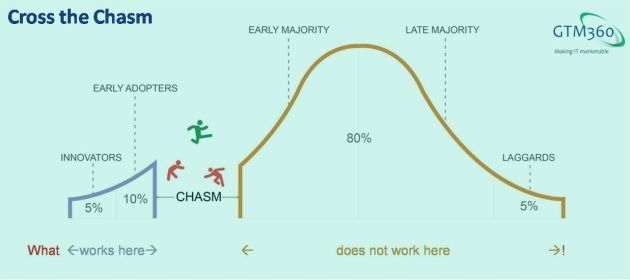
To resonate with the mainstream market, we advise these vendors to invent a competitor so that they can successfully leap the chasm and capture 85% of the market for any typical B2B technology.
Therefore, I can totally get behind the author’s observation that “smarter brands invent the enemy they want to fight“.
3. Razor Sharp Offering
I totally agree with the author’s guidance to index on sharpness over size. Instead of trying to appeal to everyone, it’s more effective to package microslices of a product into different offerings that use different hooks to attract different target groups. We do this for B2B technology offerings by creating Marketable Items that package product and services offerings into compelling reasons to buy that resonate strongly with business pain areas and industry hot topics.
4. Loss Aversion
According to the Loss Aversion principle in consumer behavior, people try twice as hard to avoid a loss than to make a profit.
Also, in a courtroom trial, while it’s the prosecution’s responsibility to prove the defendant’s guilt, the best defence lawyers don’t just sit back and hope for a “not guilty” verdict. Instead they look for alternative theories of crime in which the guilt can be pinned on some other perpetrator. In this manner, they proactively create reasonable doubt in the prosecution’s narrative and thereby plant the seeds of their client’s innocence in the minds of judge or jury.
This is another reason why the Strategic Enemy playbook works so well.
5. Why Indian Brands Shy Away
I agree with the author that Indian Brands don’t use this playbook as much as they should. I can think of two reasons for that, one cultural and the other regulatory.
Cultural: When customers ask about competitors, many Indian sales people – me included – have been trained to take the high ground and reply, “We will tell you about our product but we won’t comment on our competitors”. Accordingly, the Strategic Enemy playbook runs counter to the Sales 101 course they took.
Also, while the author tries to softpedal this approach by terming it “definition, not aggression”, creating enemies and crushing them is certainly a sign of aggression, except that, in the spirit of “all is fair in love and fair”, it may be kosher in most contexts.
Regulatory: Last I checked, Indian law does not permit comparison advertising where one brand explicitly hits out against another brand in its ad copy and visuals.
The standard “Faster, Better, Cheaper” GTM strategy that’s meant to convey superiority is good enough for evolutionary brands but I agree with the author that it’s necessary to use the Strategic Enemy playbook to create truly revolutionary brands.
That said, brands need to check whether this playbook complies with the prevailing regulations in their respective industry and is compatible with the business culture within their respective target audiences.
In case the aforementioned article is paywalled, cf. following exhibit.