The mainstream media has already started writing the obituary of Zoho’s Arattai messaging app.
Take, for example, Economic Times.
In its oped entitled Why Arattai Isn’t A WhatsApp by Akshat Khandelwal, ET writes:
Arattai will join the long list of ‘dead’ Indian apps such as Koo, Hike and Chingari that tried to punch above their weight against Silicon Valley giants, and failed.
I tend to agree with the author’s prediction – after all, Arattai has fallen out of the league table of ‘Top 100’ apps on Apple and Google app stores after topping the charts in mid-October.
However, I don’t agree with his root cause analysis or remedies.
Root Cause Analysis
According to the author:
The reason why Indian apps have consistently failed to take on Instagram, X, YouTube or WhatsApp is simple: messaging, social media and similar digital services thrive on network effects and user data, making them natural monopolies.
This RCA is simplistic, not simple. It totally misses that network effects is a retention, not customer acquisition, strategy. In other words, it helps a vendor to retain existing customers but not to acquire those customers in the first place.
Prospects who have encountered network effects with other products have experienced the helplessness that results from the vendor lockin caused by those network effects. As a result, they will get turned off, rather than be attracted, by GTM around network effects.
On the other hand, once you have a critical mass of customers, network effects will help you to hold on to them (even if they’re not so keen on holding on to you!).
To understand this better, let us take the examples of three products that are widely believed to have network effects: Google Search, Facebook Social Network, and WhatsApp Messaging.
Google was not the first web search engine. Facebook was not the first social network. WhatsApp was not the first messaging app. The incumbent leaders in those categories had network effects, however weak. Google, Facebook and WhatsApp none. Still they managed to dislodge the incumbents on the strength of their product, marketing and whatever other secret sauce they had – but not network effects. They gained network effects much later.

Proposed Remedy
The author proposes two remedies:
- Ban WhatsApp in India
- Indianize WhatsApp
History has shown that the first won’t work and the second is already a thing.
Ban WhatsApp
The author’s first remedy:
There is a very simple way to ensure that we have our own WhatsApp,…: by restricting, or outright banning, use of these foreign apps.
This is also simplistic, not simple. This remedy betrays ignorance of what happened when India banned TikTok five years ago. (In fact, the article makes no mention of the TikTok ban, which is very surprising given that the popular Chinese short video app is the only major app banned by India.)
According to Economic Times dated 18 July 2020, three Chinese apps took TikTok’s place at the top of Google Play Store within a month.

Then they were also banned. This led to a mushrooming of Indian TikTok clones e.g. Bolo Indya, Chingari, Josh, Mitron, Moj, Roposo, Trell, etc. At least three of them were well funded and became unicorns.
American apps Instagram Reels and YouTube Shorts were launched around the same time.
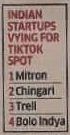 None of these Chinese, Indian or American apps had network effects – because network effects don’t grow on trees. However the Chinese apps swiftly reached the top of league of short video apps. After they were banned, the American apps took their place. Indian apps Chingari et al faded away.
This shows that network effects plays no role in acquiring customers at the start. Chinese and American apps had what it takes to acquire customers. Chingari and other Indian apps did not.
Reels and Shorts went on to develop network effects. Chingari and the other Indian apps failed to do so.
Cue to the present day. If government bans WhatsApp, what’s the guarantee that Arattai will be able to develop the required network effects? I thought so, too.
While on the topic, some people – including the author of the aforemention oped – find it fashionable to quote China to justify India’s ban of foreign apps. This is extremely misguided for at least two reasons:
- Contrary to popular misconception, China did not ban Google and Facebook. CCP imposed certain conditions around censorship and throttling of free speech on their platforms. The US giants refused to comply with those conditions and chose to exit China. If India were to follow the China playbook, and the foreign apps refuse to comply and choose to exit India, will Indians accept censorship and curbs on freedom of speech by Arattai? Going by the outrage over the government’s now-withdrawn mandate to preinstall Sanchar Saathi app on all smartphones in India, the answer to that has to be a resounding NO!
- Just because China has its own B2C apps for search, messaging and social networks doesn’t mean it’s free from all western technologies. Microsoft Windows is the #1 desktop operating system in China. SAP is the #1 ERP in China. Salesforce is the # CRM in China. Oracle is the RDBMS in China. Therefore, businesses in China are as dependent on American technology platforms as those in India. (Given that American BigTech companies derive more than half of their revenues from outside USA, that must be true for businesses in almost all countries in the world).
Indianize WhatsApp
The author’s second remedy:
An alternative policy could be to use data localisation norms to compel US giants to set up India-based subsidiaries that handle the app infrastructure, processing and Indian data locally. In other words, ‘WhatsApp India’ … would be legally and operationally distinct from WhatsApp… as a whole. This also allows potential for these apps and services to be acquired later by Indian investors, thereby paving a path for full Indianisation.
This remedy is moot for the following reasons:
- Indian data protection laws already compel all US technology giants to store Indian user data inside India – and they’re already presumably doing so.
- The Indian subsidiaries of Alphabet and Meta are incorporated in India, follow Indian laws, and pay taxes in India.
- Indian subsidiaries of foreign companies are “Indian companies” according to Indian law e.g. Pepsi India.
- Many Indian companies have bought out the stake of their foreign JV partners and achieved full Indianisation in the past e.g. Kotak Mahindra Bank – Goldman Sachs, Mahindra & Mahindra Group – Ford Motors. They can jolly well do so in the future.
- Most readers may not know this but Indian government nationalized the Indian subsidiaries of Burmah Shell, Esso, StanVac and other American petroleum companies in the 1960s to form Bharat Petroleum, Hindustan Petroleum and Indian Oil Corporation. Push comes to shove, I’m guessing it can do the same to the Indian subsidiaries of Alphabet, Meta, Microsoft, et al. (Whether it will is another story).
The author’s contention that all “US companies answer to US Congress” is silly. Both American and Indian companies in question are private sector companies and have a fiduciary duty to their shareholders. While they need to conduct their affairs in compliance with the law of the land where they operate, that’s equally true for Meta and Arattai. As a matter of fact, since Arattai’s owner Zoho has a sizeable footprint in USA, it is as much subject to US laws on data access as are Alphabet or Meta.
Having said the above, I do agree with the oped that total dependency on American apps is precarious.
My remedy against the status quo is to take a cue from how China turned the tables on Trump Tariffs negotiations. It was not via search or AI or cloud or any other technology but Rare Earth Metals. China’s counterstrategy shows that Mutually Assured Destruction leverage comes not from what you have that your adversary also does but from what you have that your adversary does not.
If we look around, we should be able to find many areas where India can gain MAD leverage against USA without banning each and every American app and trying to develop their homegrown replacements.
India’s MAD Leverage according to Grok:
– IT software workforce in GCC
– Generic drugs
– IT hardware manufacturing supply chain
etc.
Adding to https://t.co/PY9ooDLLJc. https://t.co/vUIRYLbjIW— SKR (@s_ketharaman) August 8, 2025
This rhymes with the Smartmanirbhar Bharat playbook proposed by Dhiraj Nayyar, Chief Economist, Vedanta Group:
India’s imagination of aatmanirbharta… is too broad-based and cuts across all sectors. GoI should narrow its industrial policy focus to select sectors. It should leverage India’s abundant entrepreneurial talent, and continue to look outwards at markets that are still open. And it should carry out structural reforms that make the economy truly competitive.
– Get Smartmanirbhar, Economic Times, 8 August 2025.