In a recent article in the mainstream media, Mitesh Agarwal, director, customer engineering at Google Cloud, declared:
Unlike other countries, India is a voice first market.
I found his observation a bit strange. Because it’s exactly the opposite of my observations on multiple occasions:
- People make heavy use of voicemail in USA, Germany, and UK. Whereas voicemail never took off in India. As a matter of fact, I went through a funny situation when I configured voicemail as soon as I returned to India in 2003 but my MNO didn’t! More in my blog post entitled How Does MY Telco Know That YOU Have Dialed A Wrong Number?.
- When he was the CEO of Goldman Sachs, Hank Paulson, who was subsequently the Treasury Secretary in the George W. Bush administration, eschewed email altogether and ran GS entirely via voicemails to his direct reports. Legend has it that he averaged 83 voicemail messages a day. In contrast, I know only one CEO in India who tried voicemail (as a supplement to email), and gave up quickly because his direct reports rarely listened to them.
- Voice assistant Alexa is a big hit in USA and many other markets in the West. Whereas the Amazon product failed to gain traction in India.
Going by these firsthand experiences, I couldn’t get my head around the claim that India is a “voice first” market.
But I quickly realized the root cause of this disconnect when I read the following line later in the article:
Indians are able to express things better in (voice).
Phew, it was not one of those standard gaffes made by MSM day-in day-out. But I digress.
This got me thinking that the earlier voice-first declaration might have referred to human-to-human rather than human-to-machine communications.
I agree that voice may be the go-to mode of human-to-human interactions in India. I’ve noticed that Indians express themselves much more clearly and comprehensively on a voice-based medium like podcast than in written articles. So much so that they can change the narrative.
Let me take ONDC as an example. I had a dim view of the company after reviewing its website, and wrote it off as yet another organization formed by sinecure bureaucrats without any real world business experience. I then stumbled on to an ET Morning Brief podcast that featured the founding CEO of ONDC, T. Koshy. This was three years ago. Mr. Koshy showed keen understanding of real world business and accepted the challenges posed to ONDC as a result. He just felt the noble cause was worth trying. This totally changed my mind about ONDC.
A couple of years ago, they predicted that ONDC would kill the Menu Premium charged by Restaurants via Food Delivery companies. Anyone knows how that’s working out?
— SKR (@s_ketharaman) July 28, 2024
Mr. Koshy recently quit ONDC. I wonder if his view of ONDC changed from noble cause to lost cause.
With the advent of AI, there’s another line in the above article that’s worth examining more closely:
You are calling a call centre and like to engage in a natural voice.
Personally, I’ve rarely called the call center of any brand for 10+ years ago and have instead treated Twitter As My First Port Of Call To Seek Customer Service.
Even “dumb” RPA chatbots raised the NPS rating of most brands in my reckoning to 70 over 10 years ago; “intelligent” genAI chatbots have raised it further to 90 in the last couple of years.
However, I’ve come across many people who prefer to talk to humans when they seek customer service. Take this rando on X fka Twitter, for example.
@shri_shobhit: Has it ever happened to you that you had a support issue and it was solved by talking to a chatbot? They are everywhere but it has never, ever happened to me!
To that extent, I can get behind the notion that people calling a call center would like to engage with voice.
I wonder if AI Voice Agents will change this belief.
Early reports of the technology are encouraging. Not only do they speak fluently but they’re also able to understand what the humans are saying on the other side and respond accordingly (nothing personal but I can’t say the same about many human CSRs I’ve encountered in the call centers of banks, telcos, etc.). People who have had conversations with AI Voice Agents tell me that they couldn’t distinguish between them and humans and realized that they were talking to an AI only after they explicitly asked “Are you an AI bot?” and got an answer in the affirmative.
To take an example of a real life implementation of the technology, a leading financial services company has replaced human payments collectors with AI Voice Agents. These agents call borrowers, follow up for loan repayments in English and 10+ regional languages, close the case if the borrower makes the overdue payment, or log action items in the company’s systems if s/he does not.
There’s also the well-known success story of the use of AI by Bajaj Finance, India’s leading NBFC (Non Banking Financial Corporation) to cut costs by INR 140 crores ($16M).
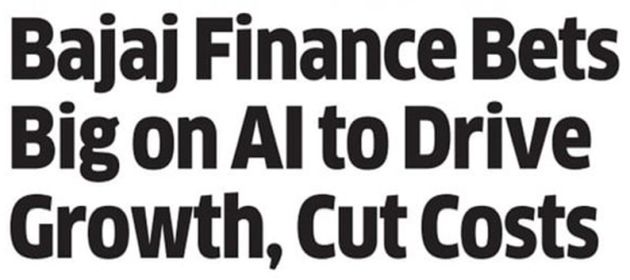
Since the Economic Times article about this initiative does not mention voice, I won’t treat it as a case study for AI Voice Agent.
It’s still early days for AI Voice Agents but, assuming the technology works as advertised, India might become known as voice first not only in human-to-human but also for human-to-machine communications.