In Calling BS Of The “Indian Market Is Big Enough For Indian Companies” Myth, we called out the challenges faced by Indian IT companies that restrict themselves to the Indian market. To do a quick recap, they include
- Low prices
- Delayed payments
- Long sales cycles
If the Indian market is not big or lucrative enough for Indian companies, what should they do?
Westward ‘ho!

We advocate Indian IT companies to go west to boost revenue, profit and valuation.
The Indian IT Services industry has followed the Westward ‘Ho strategy for a long time. It’s no secret that the Top 10 Indian IT Services companies make over 90% of their revenues from overseas markets (typically 65% USA, 20% Europe and 5% RoW) and less than 10% from India. Personally, I’ve worked in the Indian IT services industry for nearly 10 years and I can’t recall having a single customer in India.
So should Indian IT product companies. Going west is a tried-and-tested strategy. It has worked for the handful of successful Indian IT Product companies. All of them derive a substantial portion of their revenues from outside India e.g. 95% in the case of Zoho (US$ 544M out of $570M).
How do they do that?
Enter Westward ‘Ho Primer.
Many IT product companies assume that western markets are homogeneous. That’s a big mistake.
To quote an anecdote from my post entitled Upside Of Brexit For IT Industry:
When I was posted to Germany in the early 2000s to open the subsidiary of my employer for the so-called D-A-CH (German speaking) market of Europe, we had no reference customer in Germany. When prospects asked who we worked with, I listed out the names of several American customers. Prospects shook their head and asked for references in Europe. I then listed a few companies in UK. They fired back, “Oh, forget UK, they don’t even drive on the right side of the road”!
Product managers need to appreciate that each western market has its own business culture, time-poor money-rich versus time-rich money-rich ethos, nomenclature, cost versus revenue consciousness, expectation of convenience, tolerance to friction, availability of external sources of data, regulations, and so on. (Many of these factors are not relevant for services companies but they can be make-or-break for product companies.)
Accordingly, they need to tailor their product, positioning, and content separately for each western market. One size does not fit all western markets – or even all European markets.
The three steps in the early stages of your westward journey are
 Crack the value proposition of your product for the target market. See Don’t Go Global Without Cracking The Value Proposition For Foreign Markets for more details
- Create global appeal for your product. See Why Do Software Companies Outsource Product Management? for more details
- Sprinkle your product with AHA moments. See exhibit on the right for examples of features that can help you outflank incumbent market leaders.

Once you’ve batted them down, the next step is targeted and aggressive marketing.
It’s instructive to know that a typical Silicon Valley tech company spends 2.5 dollars in Marketing for every dollar spent on Product, with the multiple going above 3X in the case of outliers like Salesforce and Zoom.
The average public SaaS company spends about 50% of its revenue on sales and marketing and 20% on engineering and product
I know you want that to be the other way around
It just doesn't work that way
— Jason ✨Be Kind✨ Lemkin (@jasonlk) July 17, 2022
Zoho is a great example of an Indian IT product company that has mastered the marketing playbook that you need to spend money to make money.
Nice to see some innovative marketing from an Indian software product company. ICYMI, that's an ad from @Zoho on @Oracle 's Forbes page. pic.twitter.com/QYoM9xJFxL
— Ketharaman Swaminathan (@s_ketharaman) June 22, 2018
According to Entrakr, Zoho spent INR 1,500 crores ($200M) in Marketing (including advertising and promotion) on its revenues of INR 4274 crores ($570 million) last year.
As you navigate through these steps, be prepared to face perception challenges in western markets.
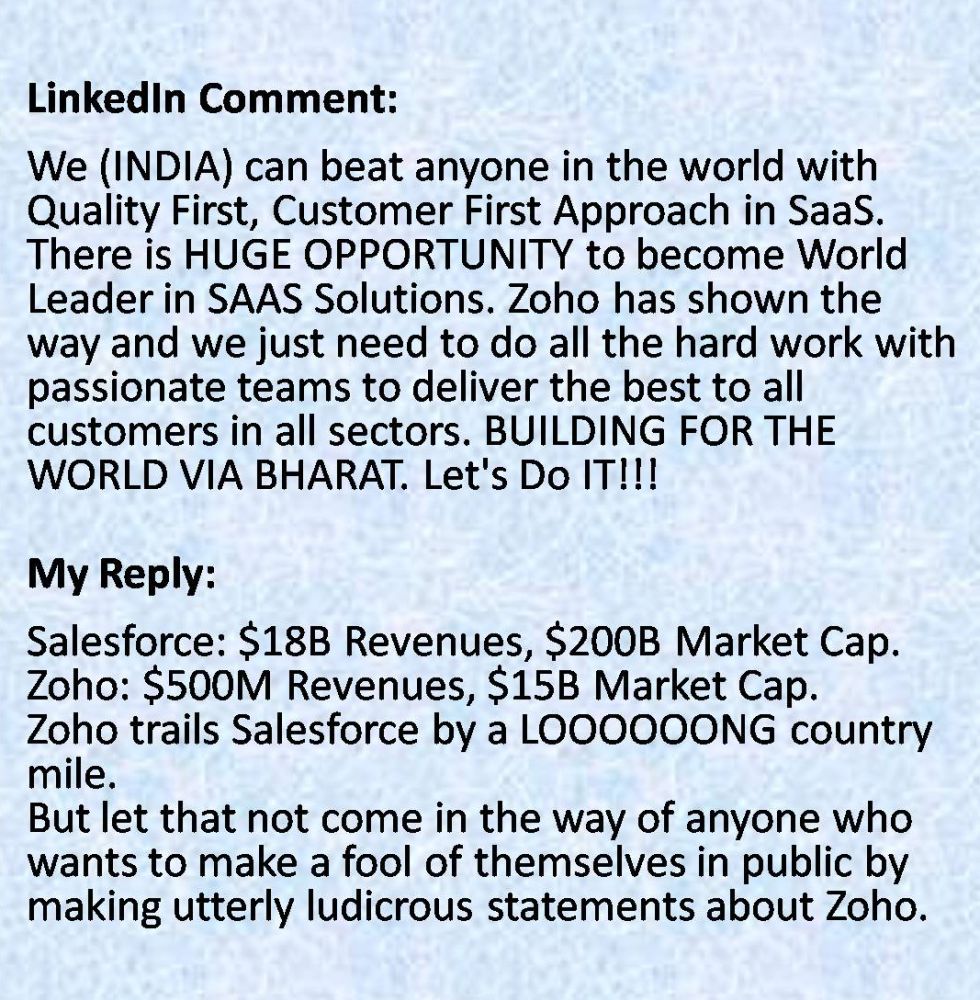 The perception problem has likely gotten exacerbated on the back of the second wave of Covid-19 outbreak in India, which has led to a lot of bad press – bordering on jingoism – against India in the New York Times and Washington Posts of America.
The standard Indian reaction has been to become defensive, cry fake news, and whine about biased reporting.
CEOs and CMOs of Indian IT companies should avoid going down that path – it doesn’t work when you’re trying to sell to western markets.
Instead, they should treat perception as reality, and work on ways to sidestep the challenges caused by it. They can find a few hacks in our blog post titled Five Ways To Fight Online Jingoism.
Chest thumping and posting in UPPER CASE à la the company founder featured in our previous post won’t help!
A special shout out to Zoho for doing a great job in this regard with its liberal dose of aggressive and targeted marketing.
Founders of some Indian companies feel that, as Indians, they should serve India before serving the rest of the world. Full marks to patriotism but there’s a major catch in that line of thinking:
Just because you want to serve India doesn’t mean that India wants to be served by you.
As I told a bank, “just because I am your Preferred Banking customer does not mean that you are my preferred bank“!
Indian market is not the sole property of Indian companies. As I pointed out in my post titled Calling BS Of The “Indian Market Is Big Enough For Indian Companies” Myth, foreign companies have traditionally dominated almost almost all enterprise software categories in India for decades.
To cite a very topical example: So many companies cropped up in India around this time last year to manufacture ventilators. But, during the current second wave of the pandemic, we don’t hear about them. Whether it’s ventilators or oxygen concentrators or whatever, everything seems to be imported from abroad.
India can progress only if our memories go longer than one news cycle. Teams that went to build ventilators & other solutions last year went out of business as our people forgot the need in winter. We got to other andholans & protests. Few months later we will forget this too.
— Balaji Viswanathan (@balajivis) April 30, 2021
So these founders should get rid of such Faux Patriotic tendencies ASAP. While they may fetch many Likes and RTs on Twitter, Faux Patriotism is not a great way to run a software company.
While we’re not into executive coaching, we can think of a very positive take on the Westward ‘Ho gameplan:
By going west, you can earn manifold higher revenues and profits, which means you can pay more taxes and thereby make a greater contribution to India’s development than by restricting yourselves to the Indian market.
End of the day, there’s more than one way to serve the nation.