From: Ketharaman Swaminathan
To: editet@timesofindia.com
Subject: Turn On the Lobby Lights
Dear Economic Times Editor:
This has reference to the article entitled Turn On the Lobby Lights by Srinath Sridharan & Anand Venkatanarayanan in today’s Economic Times.
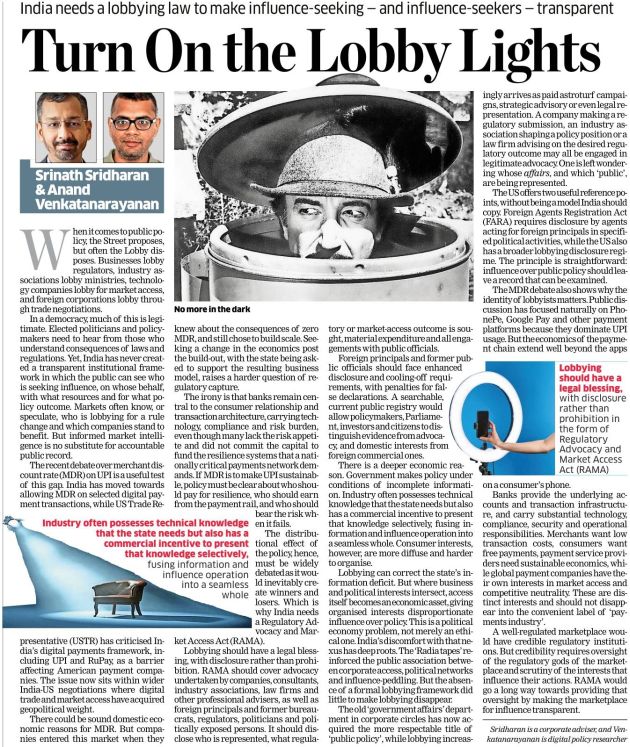
I totally agree with the authors that it’s high time lobbying became kosher. It will drive collaboration between regulators and industry experts and thereby help regulators make rules that reflect business conditions better instead of announcing them with a harebrained understanding of how business works, and diluting / withdrawing them later when it becomes clear that they will not work in the real world.
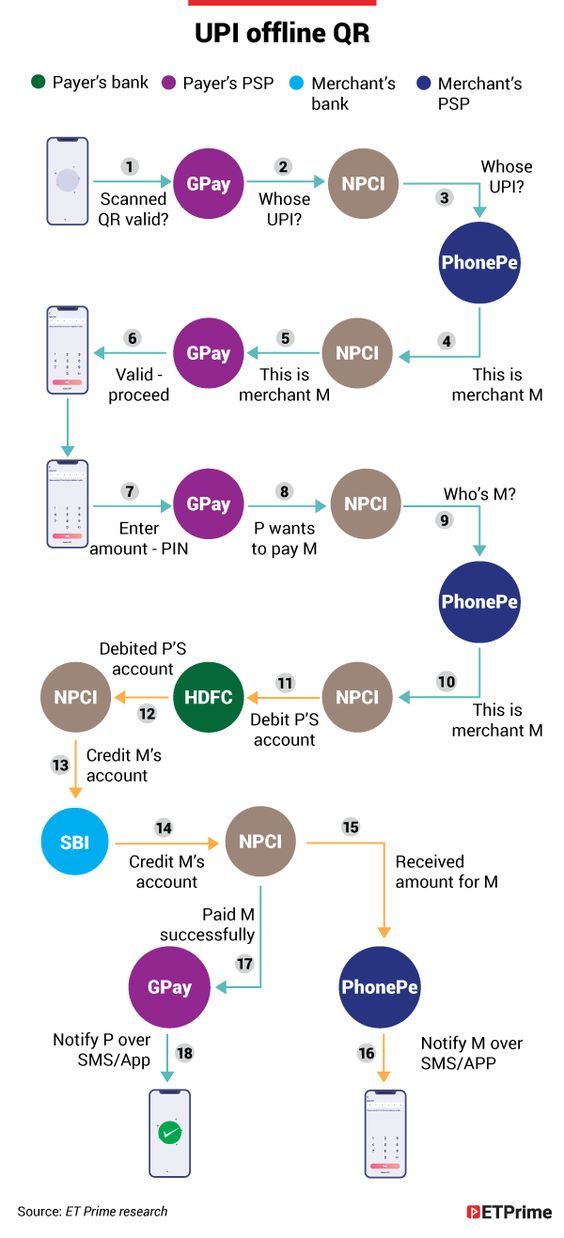 Like the authors, I too noticed that the public discourse on the recent repeal of Reg Zero MDR on UPI payments has focused too much on Walmart PhonePe and Google Pay (probably because together they process 85% of UPI TPV).
As you can see from the exhibit on the right, Google and PhonePe are but two of the many entitites involved in the end-to-end payment value chain of a typical UPI payment transaction. In the industry parlance, they’re called Third Party Payment App (TPAP), with the other entities being Issuer Bank, Acquirer Bank, and Payments Services Providers (PSPs).
I see this as a repetition with what we saw with credit card.
The common man / woman (henceforth J6P for Joe Six Pack or Jane Six Pack) associates credit cards solely with Visa and MasterCard and tacitly assumes that the two credit card networks earn the entire MDR revenue. That’s far from the truth. In reality, of the ₹2.38 MDR typically applicable to a ₹100 purchase paid with a V/MC credit card, the American payments giants earn only ₹0.24, with the balance ₹2.14 shared by the Issuer Bank, Acquirer Bank and the Payments Services Providers, all of whom are domiciled in India and pay taxes in India.
In the case of UPI, in their capacity as TPAP, Google / PhonePe will earn only 8 points out of the 40 points of UPI MDR, with the remaining 32 points shared between the other entities involved in the UPI payment value chain.
 I however disagree with the authors’ contention “companies entered this market when they knew about the consequences of zero MDR, and still chose to build scale”.
No, they didn’t.
UPI attracted ~0.6% MDR during the four year period since its launch in 2016 until Reg Zero MDR came into effect on 1 January 2020. So, when Walmart PhonePe, Google Pay and other PSPs entered the market and built scale, they couldn’t have known about zero MDR because MDR was not zero at the time.
On a side note, I pasted the text of the aforementioned Economic Times article to Pangram, the most popular AI Detector tool in the market. It reported that 91% of the article is generated by AI. I haven’t heard anything on ET’s stance towards AI-generated content but, going by Wall Street Journal, it might not bother too much. When a recent oped by Wall Street investor Stanley Druckenmiller in WSJ was found to be 100% AI-generated, the newspaper’s opinions editor brushed it off by saying it’s Saul Goodman.
Thanks and Regards.

KETHARAMAN SWAMINATHAN
24 August 2026