Indian IT industry did many big ticket M&As in FYE 2026. Despite that, no Indian IT company made it to the latest FORTUNE GLOBAL 500 list. This runs counter to my prediction that M&A will propel the Indian IT industry to Fortune Global 500.
Before we get into the Indian IT industry, here’s a quick recap of the list of 500 largest corporations in the world (by revenues) this year.
FORTUNE GLOBAL 500
 AMAZON became the largest company in the world. For as long as I can remember, WALMART has occupied the number 1 spot on Fortune Global 500. By earning three billion dollars greater revenues, Amazon surpassed Walmart on the way to the top of the global corporate totem pole.
Some 20 years ago, I read a line about Walmart that became one of my favorite quotable quotes: “Walmart is the #1 company on the FORTUNE 500 list. So it’s BIG. So big that if the pilferage from Walmart were incorporated into a separate company, that company would rank 276 on the FORTUNE 500 list.”
I wonder if that’s Andy Jassy’s favorite line as well.
As soon as Amazon hit the top spot on FORTUNE 500 list this year, the CEO of Amazon made a similar statement about how AWS would rank #24 on FORTUNE 500 if it was a standalone company (see footnote 1). For perspective, before he took over as CEO of Amazon from founder Jeff Bezos, Andy Jassy was the CEO of AWS.
The contours of Fortune Global 500 are shaped by Amazon at #1 and PayPal Holdings at #500 rank.
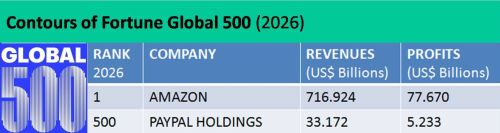
The corporations on the list together generated $43.1 trillion in revenue, up 3.2% from the previous year. This represents about one-third of the world’s GDP. Collectively, they employ 70.2 million people. The Global 500 had its most profitable year ever, with combined profits of $3.39 trillion.
As a nod to the AI boom during the year, AI chipmakers Nvidia and Taiwan Semiconductor leaped, respectively, 38 spots to No. 28, and 44 spots to No. 82. The semiconductors and electronic components industry’s rise also brought Netherlands-based ASML onto the list at No. 453 for the first time. Chinese tech companies Tencent and Alibaba rose, respectively, 19 spots to No. 97 and seven spots to No. 56.
But the gains weren’t confined to upstart tech:
Healthcare colossus McKesson, one of 138 companies that have been on the list since 1995, also broke into the top 10, at No. 7.
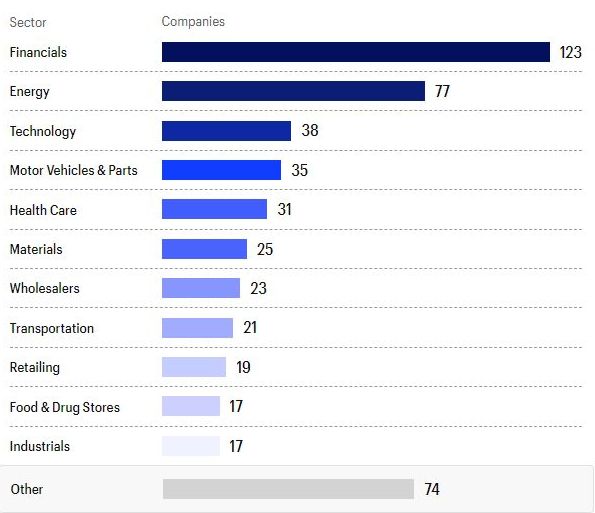
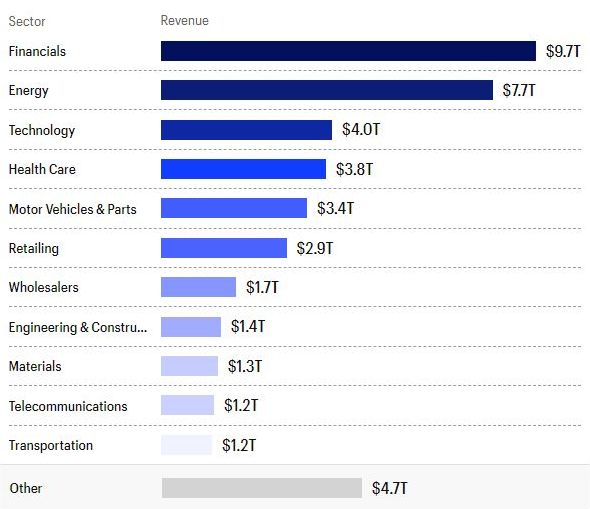
And, as usual, FINANCIALS continues to be the biggest industry on Fortune Global 500 – both by number of companies…
and revenues.
INDIA IN FORTUNE GLOBAL 500
Reliance Industries (#85) has moved up three ranks from #88 last year, and continues to top the league table of Indian companies in Fortune Global 500.
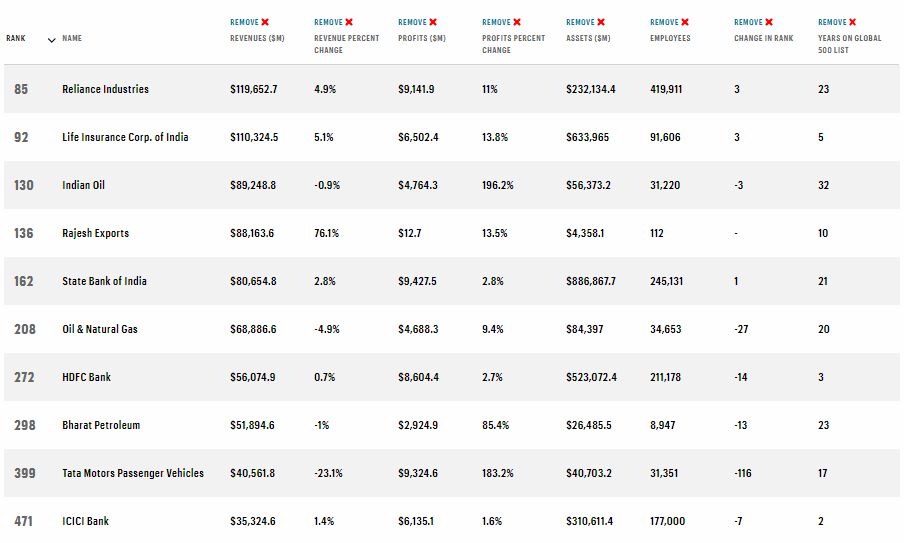
Rajesh Exports re-entered the list at #136. During the year, there was a lot of buzz about accounting irregularities in the Bangalore headquartered import-export company. That has not affected its standing on Fortune Global 500. Only time will tell whether it’s a classical case of dead cat bounce or those rumors stemmed from a misunderstanding of the firm’s revenue recognition practices (see footnote 2).
With Rajesh Exports entering and no company exiting (knock on wood!) Fortune Global 500, India has added one more entry to this year’s list and has 10 companies on it (see footnote 3).
I noticed that Life Insurance Corporation of India (LIC) ($110B) is within a touching distance of Reliance Industries ($119B) and has a higher revenue growth rate. Let’s see if the public sector insurance giant displaces the oil-petrochemicals-retail-telecom-digital conglomerate from the top of the list anytime in the near future.
FORTUNE GLOBAL 500 QUALIFYING REVENUE
The Fortune Global 500 Qualifying Revenue rose by 2.86% to $33.172B.
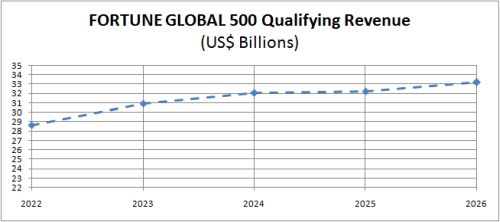
For the uninitiated, Fortune Global 500 Qualifying Revenue is the revenue hurdle that a company must cross to enter the hallowed corridors of the 500 largest corporations in the world. In other words, it’s the revenue of the last company on the list i.e 500th rank holder.
FG500-QR has grown YoY every year in the last decade except in 2016 and 2021. The latest year’s growth rate (2.86%) is better than last year’s (0.53%) but it’s not among the highest five CAGRs during this period.
INDIAN IT INDUSTRY
The league table of the Indian IT industry remain unchanged: TCS, Infosys, HCL, and Wipro continue to be the top four companies in the industry for FYE 2026 (i.e. 1 April 2025 – 31 March 2026). Their revenues for the last two financial years is given in the following exhibit.

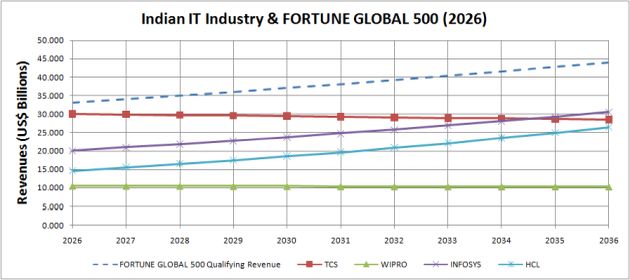
As in the past, I forecasted the revenues of the four companies for the next 10 years by extrapolating their current CAGRs and juxtaposed them with the projected FG500 Qualifying Revenue for the same period. The following chart is the result:
(Click here to download the Excel model)
For the first time in my memory, TCS has shrunk (-0.53% CAGR).
FG500-QR up. TCS down.
The story writes itself: TCS will not enter Fortune Global 500 list at its present CAGR. If TCS won’t, it should be obvious that no other Indian IT company will, either. Their forecasted revenues for 2036, the last year covered by my model, confirms this:
- TCS: $28.47B
- Infosys: 30.53B
- HCL: $26.43B
- Wipro: $10.28B
As you can see, none of the four Indian IT majors comes anywhere close to $43.99B, which is the forecast for FG500-QR for 2036.
This is frankly disappointing, especially since Indian IT companies did do many big ticket M&A deals this past year.
- Coforge – Encora: $2.35B
- TCS – Coastal Cloud: $700M
- Infosys – Optimum Healthcare: $465M
- Wipro – Mindsprint: $375M
- HCL – Jaspersoft: $240M.
That said, most of these M&As happened midway through FYE 2026. It might take a full fiscal year for their revenues to be fully reflected in the PLBS of their new owners.
While on the subject, there’s tremendous disconnect on the actual M&A values for FYE 2026, with figures swinging wildly between $29B and $5B.
M&A by Indian IT Services industry in 2025:
* $29B per ET article dated 29 Dec 2025 (https://t.co/VB6qyYzWiy).
* $5B per ET article dated 21 Jan 2026 (https://t.co/ucj8bLTZh4).
Which figure is correct? Obviously both can’t be.— SKR (@s_ketharaman) January 21, 2026
Interestingly, at the present CAGR, Infosys ($29.28B) will overtake TCS ($28.62B) in 2035!
This year is probably the high watermark for the doomsday prophecy caused by AI for IT services in general and Indian IT services industry in particular.
I’m not so pessimistic. IT services companies generate a bulk of their revenues from three service lines:
- Application Development & Maintenance
- Product Oriented Services
- Outsourced Product Development
In the worst case scenario where AI vibe coding slashes labor by 75% in ADM, 25% in POS and 50% in OPD, the overall reduction in headcount would be of the order of 50%.
This does not automatically mean the industry will see a 50% reduction in its revenues.
In its entire 40 years’ existence, the Indian IT Services industry has sold capability but priced headcount (whether in T&M or Fixed Price engagements). There are many other building blocks of capability apart from labor. I see ample opportunity for Indian IT companies to raise their value proposition with better marketing, and thereby protect their revenues. Please reach out to us to know more about that GTM playbook.
Then there’s also the emerging opportunity from Enterprise AI Services, which is not included in the above list of horizontals. This service line comprises selection of LLMs; identification of use cases; data preparation for training, finetuning and RAG (Retrieval Augmented Generation); prompt engineering; creation of governance frameworks; program management; managed services for ongoing maintenance; and so on (see footnote 4). According to Economic Times, for every $1 spent on AI software, enterprises will spend $14 on AI Services. For reference, the license-to-services revenues for ERP, CRM and other enterprise applications is 1:3. You can imagine the humongous revenue the 14X multiple can contribute.
I wouldn’t be surprised if AI Services one day drives more revenues to the Indian IT Services industry than all the traditional service lines put together.
FOOTNOTES:
- #45 on Fortune Global 500, though.
- Retailers recognize revenues on gross basis. Marketplaces do so on net basis. How should an import-export company?
- I’ve a vague memory of seeing Hindustan Petroleum Corporation Limited on Fortune Global 500 in the past. I don’t see it now. If my memory is right, it means HPCL exited the list sometime in between.
- Traditionally, IT services companies have not included data services in the scope of work of their ERP / CRM enterprise applications implementation projects. I suspect that will change in AI. Mainly because (a) Data-related work is often the first dollar of spend made by many enterprises embarking on AI initiatives, and (b) They may be forced to take it up in order to compensate for the loss of revenues from extensions and customizations, which will likely be rekt by AI vibe coding.