Outcome Based Pricing (OBP) is where my product helps you to achieve a certain outcome, I sell it to you for a price that’s proportional to the monetary value of the outcome, and you pay me after you achieve the outcome.
Example: My ERP helps you to reduce your Accounts Receivables. You buy my ERP and get a reduction of DSO from 90 to 30 days. That translates into a working capital savings of $100M for you. You pay me 10% of that, i.e. $10M.
In Output Versus Outcome Based Model, I wrote:
The mainstream market does not buy technology for the sake of technology but to leverage technology to get manifold returns in business outcomes like revenue, profits, etc. As a result, customers are loath to part with a chunk of the monetary value of the outcome in return for technology. Ergo they opt for output based model where they can get to extract unlimited value in return for a fixed cost.
This is implicitly true for tried-and-tested technologies that have a solid track record of delivering manifold returns in business outcomes.
In the case of a new technology like Artificial Intelligence, more specifically Generative Artificial Intelligence and Agentic AI, the technology is in nascent stages and it does not yet have a solid track record of of delivering manifold returns in business outcomes.
Therefore, it’s natural for customers to be skeptical about the business outcomes they will get from AI, and demand some kind of skin in the game from their vendors.
Some vendors are responding with the classical outcome based pricing model defined above.
But many vendors are offering an alternative model whereby they charge a predecided price that is not proportional to the monetary value of your outcome but agree to take part of their payment after you achieve the outcome. I call this Outcome Driven Payment (ODP) model.
Example: I sell you an ERP for $1M. You pay me $1M after you achieve the reduction of DSO from 90 to 30 days.
This is a variant of Output Based Pricing model we discussed in Output Versus Outcome Based Model, except that the payment terms are linked to outcome realization.
Different customers will have different monetary value for the same outcome. To continue with the above example, a company with $10B revenue will have a higher monetary value for the same 90 to 30 days DSO reduction compared to another company with $10M revenue.
In the case of OBP, my price for the given product will be different for different customers. In the case of ODP, my price for the given product will be the same for all customers.
To take an example:
Outcome Based Pricing: Credit Card processing. A merchant signs up for a merchant account with an Acquirer Bank. He accepts a $100 credit card payment and bank keeps $2. He accepts $1000 credit card payment, bank keeps $20. Notice that, for the same product – credit card processing – the bank earns different fees. This is also called ad-valorem pricing.
Outcome Driven Payment: A2A processing. Whether the merchant receives $100 or $1000 via Zelle / FPS / NEFT / IMPS / RTGS, the bank charges the same fee of $1. This is a flat fee. But it receives the $1 only if the A2A payment is successful.
Of late, in AI deals, I’m seeing a lot of ODP being spun as OBP.
I call this Outcome Washing (H/T greenwashing).
Let’s take an example.
According to Economic Times article entitled “IT Scrambles For Benchmarks As Clients Eye Outcome-Based Deals“, 20-30% of fees in IT and BPO contracts are linked to business outcomes like faster claim cycles and improved NPS.
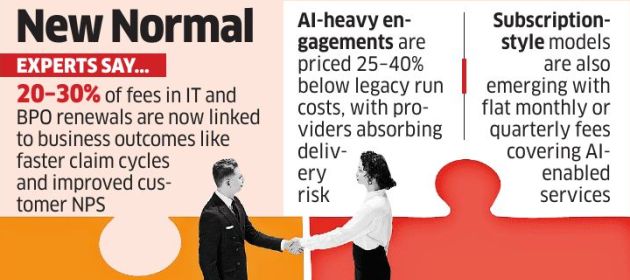
Instead of receiving 100% of their fees against supply of the software or services, vendors will now get only 70-80% against that milestone. They will need to wait for the customer to achieve the promised business outcome like faster claim cycles to receive the balance 20-30% of the fees. If the customer does not achieve the said business outcome, the vendor will need to forego the 20-30% of their fees and settle for the 70-80% they received earlier.
Note that in these cases, the contract size is fixed by the vendor. It might be estimated on the basis of T&M or fixed price but it’s not related to the monetary value of the shortened claims cycle or improved NPS.
This is Outcome Driven Payment, not Outcome Based Pricing.
Lesson for IT and BPO vendors: When a prospect demands outcome-based pricing, check whether they mean OBP or ODP. While OBP carries a high risk, the risk in ODP is more manageable. It has parallels with deferred payments arising out of good old clauses like performance guarantee and retention payment that vendors have handled for a long time, so it could be a nothingburger.
 While on the subject of outcome in AI deals, enterprise customers are also mindful of bad outcomes e.g. hallucination.
To protect their interests, they’re expecting vendors to underwrite the full extent of damages caused by their products and services. This has translated into “unlimited liability” clause in AI contracts. According to Economic Times article entitled What’s slowing Indian IT’s AI deals?
Unlike traditional software systems, artificial intelligence is probabilistic. So, clients are asking IT service providers to sign contracts with ‘unlimited liability’ clauses in case the AI system makes mistakes.
While unlimited liability has been a standard clause in all software contracts in USA, deals for traditional software in the rest of the world including Europe and India generally have capped liability to the contract value. Going from there to unlimited liability is a big jump. Lawyers are lawyers whether the software is AI or something else, so they’re not going to agree to unlimited liability so easily. As a result, vendors report that it’s taking longer to sign AI contracts than contracts for other technologies.