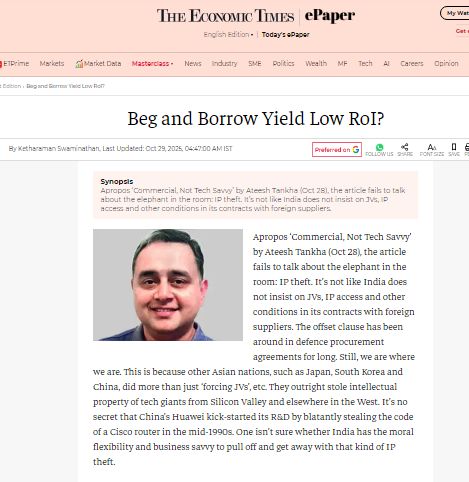
 When some rando shills China’s R&D playbook for India on social media, it’s funny.
But if a leading columnist does the same in the world’s second largest business daily (see footnote 1), it’s no laughing matter.
When that happens, it must be rebutted.
Consider it done.
—–
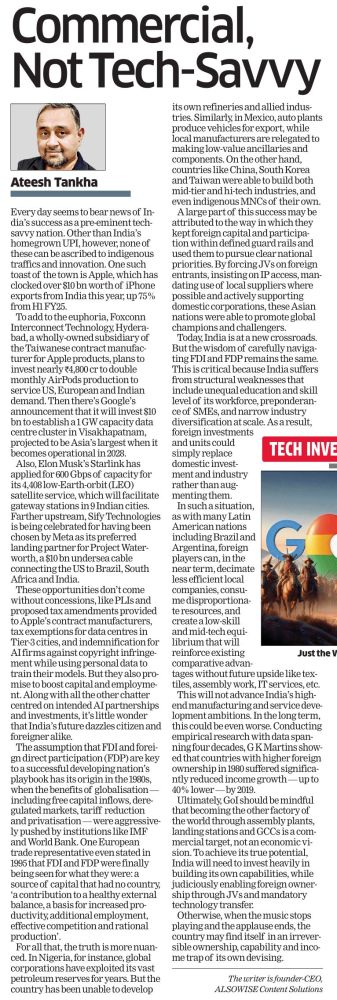
In his op-ed entitled Commercial, Not Tech-Savvy in Economic Times, Ateesh Tankha proposes the Chinese R&D playbook for India.
In my opinion, this advice misses how China got its start in R&D.
In the late 1990s, Huawei was accused of copying the intellectual property of Cisco router.
This marked a watershed moment in China’s R&D program.
Since then, there are many documented cases of alleged or proven intellectual-property (IP) theft, trade-secret misappropriation and technology transfer from the West to Chinese companies (or entities linked with China).

A partial list of these IP thefts is given below:
- Cisco Systems v. Huawei Technologies: In 2003 Cisco sued Huawei, alleging that Huawei had “copied” Cisco’s source-code, router user manuals, command-line interface design and help-screens. The copying was so extensive that even bugs and bug codes from Cisco’s software appeared in Huawei products (see footnote 2)!
- Micron Technology v. Fujian: Fujian Jinhua Integrated Circuit Co. (China) is a Chinese state-owned DRAM manufacturer. It is a major part of China’s “Made in China 2025” initiative to achieve self-sufficiency in semiconductors.
- American Superconductor Corporation (AMSC) v. Sinovel Wind Group (China): An engineer at ASMC stole AMSC’s entire software code and passed it to Sinovel. Sinovel then allegedly used that code in turbines and refused to pay licensing fees.
- US Congress v. China: A US Congressional document notes several cases of Chinese nationals or entities stealing IP or biological materials from Western universities and companies (e.g., GlaxoSmithKline, Ventria Bioscience, etc.) and transferring it to Chinese firms.
- USA v. China: Chinese-linked hacking groups (e.g., named APT groups) have been accused of exfiltrating large volumes of IP from Western firms.
These cases show that China’s theft is extensive, involves state-backed firms, covers strategic IP and physical products, and goes beyond IT / Telecom industry to encompass biotech, energy, pharmaceuticals, and other sectors.
I must hasten to clarify that I’m not claiming that China got its R&D mojo solely by stealing IP from USA. I only contend that its R&D program got its start via IP theft from USA.
I concede that R&D has a lot of other ingredients. To that extent, IP theft is only a necessary, but not sufficient, condition.
But it cannot be denied that China stole IP theft to prime its R&D pump.
Some people try to spin China’s theft as “rebuilding technology from scratch using the knowledge in the heads” of Chinese scientists and engineers returning to the motherland after working in the West. But, as the above examples show, that’s not true – nobody can carry seven million lines of code in their head and rewrite them from memory.
It’s not only China. Even Japan and South Korea have been accused of reverse engineering Western products and developing their own clones in the three to four decades before China did so in the 1990s and 2000s.
I doubt if India has the moral flexibility and business savvy to pull off – and get away with – the kind of IP theft as its Asian neighbors, especially China, have done.
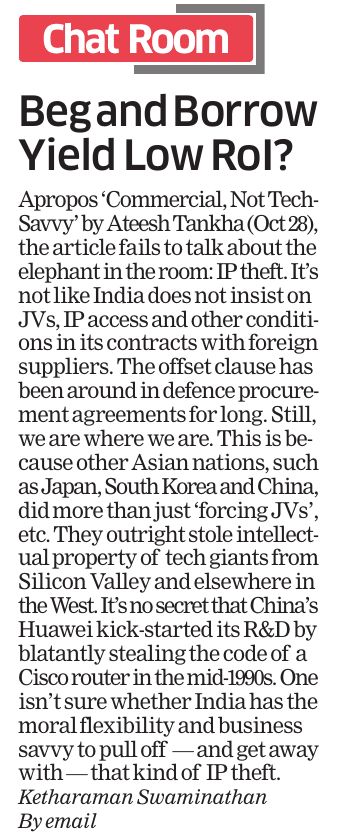
A condensed version of the above post was published by Economic Times on 29 October 2025.
In case the aforementioned op-ed titled Commercial, Not Tech-Savvy in Economic Times is paywalled, cf. following exhibit.
FOOTNOTE(S):
- Some 15-20 years ago, Economic Times used to claim that it was the “world’s second largest business daily” (after Wall Street Journal). Given the steady rise of print media in India and fall in USA since then, I won’t be surprised if ET has overtaken WSJ by now. But, since I haven’t heard ET claim that it has become the largest business daily in the world, I’ll continue to refer to it as the #2.
- This reminds me of the Tamil phrase “ஈ அடிச்சன் காப்பி” (Eee adichan copy), which literally translates to “fly-swatted copy”. It refers to a student who copies another student’s notebook so identically that if a fly had landed on the original page and left a mark, he’d also reproduce that mark in his notebook!