I have been asked many times to explain the difference between AI Agent and RPA. That’s not strictly true. I’ve been asked only twice, most recently by an automated bot on X fka Twitter (see footnote 1).
Since two is more than zero, here goes.
Like cron, scripting, and RPA (Robot Process Automation), Agentic AI also automates manual tasks and workflows.
But the similarity ends here.
The old and new technologies differ vastly in terms of how they carry out the automation.
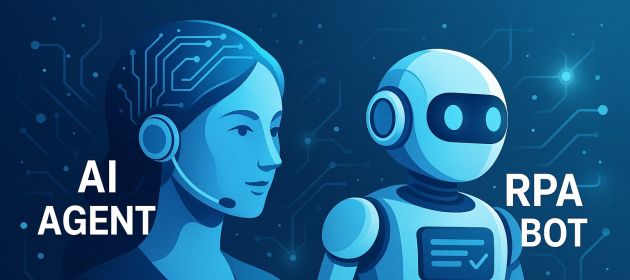
RPA automates repetitive tasks, such as responding to pre-defined queries whereas AI Agent can analyze natural language, understand context, and engage in dynamic conversations apart from being able to handle ambiguous queries, escalate complex issues, and continuously improve from interactions via machine learning.
To take an example, suppose you post an opening for a Data Analytics job and use an Application Tracking System to screen the applications you receive. An RPA-based ATS would dumbly reject an applicant if her resume lacks the keywords “data analysis” whereas an Agentic AI-based ATS will smartly shortlist her if her resume mentions Python, R, SAS or other popular data analysis languages, tools and platforms.
By the same token, an RPA will be fooled into accepting an applicant for a job opening that’s restricted to IIT graduates if it sees the sneaky expression “not from IIT” in her resume whereas an AI Agent will astutely reject her and probably mark her resume for blacklisting.
This resume hack may have passed the traditional resume filter. But, it will get thrown out by modern ATS systems that use Agentic AI, and marked for 1-3 years blacklisting as punishment.
— SKR (@s_ketharaman) August 19, 2025
Let me give another example of RPA v. AI Agent capabilities stemming from two tasks in my content marketing playbook.
- Whenever I publish a new post on my blog, post its link on X fka Twitter along with its lede.
- Whenever I reply to a post on Twitter, add the link to my blog post that’s most relevant to the topic on hand.
The first task can be fulfilled easily with RPA. In fact, there are some WordPress Plugins for this.
For my second task, here’s what I’ve being doing until recently:
- Try to remember if I’ve blogged about the topic on hand
- Search for the blog post by my vague recollection of keywords in it
- Click through to the blog post, copy its URL from the browser address bar
- Paste the link to my tweet
- Hit Reply.
Since I’ve been blogging for nearly 20 years and have written close to a million words, the very first step in the above workflow can often be challenging. Assuming I get past it, the second step can be even more daunting because it’s very hard to remember the exact keywords that I need to enter into WP-Search box to find the blog post. Since I cannot write a rule for these steps, RPA is ruled out.
I then tried genAI / ChatGPT based only on the overall theme of the tweet on hand i.e. without trying to recollect keywords on my blog. It worked! More details can be found in my blog post titled How My Quest For Semantic Search Ended With ChatGPT.
Once I get the title of the relevant blog post from ChatGPT, I carry out steps #3 through #5 manually.
In short, I’ve used ChatGPT to partially automate my second task. This is an example of “man in the loop” automation.
I’m now exploring if this task can be fully automated with an AI Agent i.e. achieve “man out of the loop” automation. If you have any tips in this regard, it’d be great if you can add them to the comments below.
Generative AI helps you do it. Agentic AI does it for you.
(see footnote 2).
For more examples of AI Agent versus RPA, click here.

Now, let’s see the significance of the RPA v. AI Agent capabilities in business.
I’ll take the case of GST Notice to explain this.
In his op-ed entitled “Good, Simple Tax—Finally?” in Economic Times dated 18 August 2025, author Vivek Johri points out that too many GST notices are sent out under the current GST enforcement regime. In just December 2023, demand notices totaling INR 1.45 lakh crore ($15B) were issued to around 1,500 businesses.
Arguing (rightly!) that such backlogs lead to protracted litigation and heavy strain on the dispute-resolution mechanism, Mr. Johri recommends a more nuanced approach in which notices would be sent out only for egregious violations of GST law.
“CBIC is working on a new invoice management system that will prevent notices being sent automatically to taxpayers for mismatch in GST returns”.
New software to disable features of old software is the wet dream for IT Services industry!— SKR (@s_ketharaman) October 13, 2025
The author’s vision for a new GST enforcement regime is a low hanging fruit for Agentic AI.
I’ve no inside track into the current GST enforcement system but the barrage of notices currently sent out by GST Department is consistent with systems built using RPA or some other traditional automation technology. Based on rigid business rules, these systems generate notifications for all kinds of infractions.
The author’s proposal for a system to distinguish between trivial and egregious violations of the GST law is right up the alley of modern Agentic AI systems. In fact, AI Agent’s ability to take such a nuanced approach is its fundamental differentiator vis-a-vis previous generations of automation technologies. Trained on GST data, intelligent AI agents can separate minor violations from major ones and only dispatch GST notices to the major violators.
 In this manner, Agentic AI technology can improve the effectiveness of GST enforcement without coming across as “tax terrorism”, or increasing the compliance overload for businesses, or both.
In making the shift to Agentic AI, we need to be mindful of the fact that existing automation technologies are deterministic whereas AI is stochastic. To that extent, the AI system will exhibit some degree of False Positives.
However, I reckon that it won’t be too hard to filter out wrong notices from all notices since AI will dramatically reduce the total volume of notices generated in the first instance.
For reference, early adopters of Agentic AI in other fields like IT System Monitoring & Observability are already seeing a 85% reduction in “noise” level compared to non-AI systems. See the exhibit on the RHS for a quick overview of AI Agent v. RPA in ITSM.
RPA and other traditional automation technologies are deterministic and work on the basis of rigid business rules whereas AI Agent is stochastic and exhibits intelligence. This translates into sharp differences between the two technologies along three dimensions:
- Flexibility: Agentic AI cracks unstructured, unpredictable inputs, while RPA is limited to structured, predefined scenarios.
- Learning: Agentic AI continuously improves with data; RPA does not learn beyond its initial programming.
- Scalability: Agentic AI can handle edge cases and variability, making it suitable for complex, evolving tasks. RPA excels in static, repetitive workflows.
FLS framework someone?
FOOTNOTE(S):
- Fans of Joseph Heller might find a striking resemblance between this passage and the opening passage of Good As Gold, one of my all time favorite novels. I apologize in advance to the Estate of Heller for taking the liberty of paraphrasing what’s one of the most captivating novel starts that I’ve ever read.
- The “it” in this definition can be “run an email marketing campaign” or “post an update on LinkedIn” or “raise a purchase requisition on ERP from supplier’s handwritten quote“, and so on.