Ever since Donald Trump started talking about tariffs (1988) and first imposed tariffs (2018), the mainstream media has been parroting the pedantic economics theory that tariffs is a form of tax on US consumers.
When Trump reiterated his intention last year to impose tariffs if he was elected the President of the United States, MSM went into a overdrive and warned that USA would face severe inflation if tariffs became real.
Trump was voted POTUS in a landslide victory and announced Trump Tariffs in March-April this year. Media created massive FUD (Fear Uncertainty Doubt) that Trump Tariffs would lead to empty storeshelves, massive inflation, and crippling recession by June.
None of that happened.
Store shelves were not empty in June or any other month after that. There’s no major inflation. USA just posted blockbuster GDP growth of 3.8% in the second quarter of 2025. The US stock market is at all time high. A basic S&P 500 index fund is worth 90% more than three years ago.
“The broadest measure of economic output, inflation-adjusted gross domestic product, grew at a blistering annual rate of 3.8%” ~ https://t.co/ghriCB8fr9.
USA GDP growth rate: 3.8%.#WSJ— SKR (@s_ketharaman) October 27, 2025
I took a contrarian view since I thought of tariff as a practical sales / purchase construct instead of viewing it from the lens of economics theory. My conspiracy theory that dealmakers will trump economists in predicting the impact of tariffs has now become a media story.
At the start of this year, there was consensus among economists, bankers, investors and business community that Trump tariffs would be disastrous for the US and world economy. Tariffs, they warned, would cause massive disruptions in global supply chains, sharply reduce world trade, raise inflation and shrink the world GDP. In April, Paul Krugman wrote how malignant stupidity will kill the world economy. So far, there is no sign of recession. – A Crash Course in Restraint, Economic Times.
After advancing many reasons why American Consumers Won’t Pay Pay The Price of Trump Tariffs, I argued that the bulk of the burden of Trump Tariffs would be borne by Foreign Exporters and American Importers aka the Supply Chain.
Most economists says tariff is paid by the consumer. Some economists say it’s paid by the supplier. As a career sales professional in my past corporate life and a businessman in my current entrepreneurial journey, I believe such costs are shared by all parties. It all depends on margins, compelling need for the market and compelling need for the goods. – Dealmakers Trump Economists In Predicting The Impact Of Tariffs
I’m happy to announce that my prediction is vindicated by live data.
In what’s perhaps the first study on the actual impact of Trump Tariffs, Goldman Sachs (see footnote 1) reports that Trump Tariffs are borne by the various parties in the following proportion:
- Foreign Exporters: 14%
- American Importers: 66%
- American Consumers: 20%
So 80% of the burden of Trump Tariffs is indeed borne by the supply chain rather than American Consumers.
MSM screams inflation in the headlines and ascribes the burden of Trump Tariffs thusly in the body of its articles:
- The burden has already been passed on to American Consumers
- Foreign Exporters are bearing the burden
- American Importers are bearing the burden
- The burden will be passed on to American Consumers in future.
These four themes group neatly into two MECE (Mutually Exclusive and Collectively Exhaustive) scenarios as follows:
- American Consumers are bearing the burden of Trump Tariffs (#1)
- American Consumers are not bearing the burden of Trump Tariffs (#2, 3, 4)
I uploaded four articles of this nature to ChatGPT and asked it to count the total mentions of A and B in them (see footnote 2).
It outputed the following table.
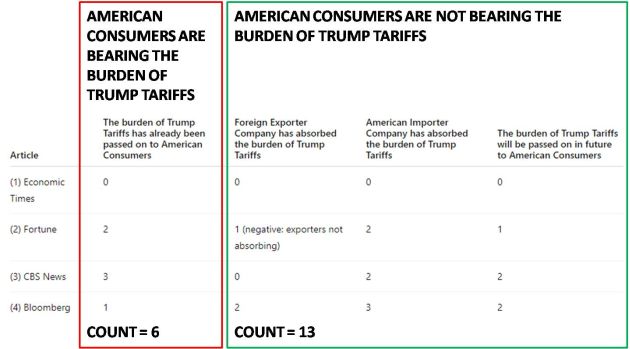
As you can see from the above exhibit, the count of A is 6 and B is 13.
This shows that the headlines on inflation are merely headline bait.
MSM says that American Importers will eventually pass on the burden to American consumers. But that’s what it has been saying forever. Business is judged every quarter. Too early or too late are both equally wrong. “Eventually” has no meaning.
Fact is, as of now, store shelves are not running bare, USA is not crippled by soaring inflation, US economy has not slipped into recession.
“Economists predicted 10 out of the last 3 recessions”.
BUT
“Economists averted 7 out of 10 recessions by giving early warning”.
— GTM360 (@GTM360) April 29, 2020
MSM is the broken clock that should be ignored even if it’s right twice a day.
After reading my previous blog posts on Trump Tariffs (see RELATED READING below), a few readers reached out to me with the following questions:
- Why would American Importers absorb the burden of Trump Tariffs?
- Why would Foreign Exporters absorb the burden Trump Tariffs?
- How can Foreign Exporters pay Trump Tariffs?
All of these questions show a keen understanding of the economic theory of tariffs.
In a follow-on post, I’ll answer them from the perspective of a practical business. Watch this space.
RELATED READING:
- 10 Things They Didn’t Tell You About Trump Tariffs
- Dealmakers Trump Economists In Predicting The Impact Of Tariffs
- Trump Tariffs: 7 Reasons Consumers Won’t Pay The Price
- Globalization – Good or Bad?
FOOTNOTE(S):
- If it says Goldman Sachs on the outside, everybody believes what’s on the inside, but I really wonder how anyone can get hold of such data. After all, B2B contracts are confidential and prices agreed between Foreign Exporters and American Importers are not released publicly. How much an exporter reduced his base price, how much tariffs an importer absorbed versus how much he passed on to consumers – all of these are highly confidential SKU-level data. When my old company Oracle acquired Retek, we got a quick overview of the key functionality of the software considered to be the retail tech leader. IIRC, SKU-level cost data is not even disclosed to store managers at big box retailers, let alone to the general public.
- This was a semantic, not keyword, search. I’ve a pretty good experience of using ChatGPT for semantic searches, as I described in How My Quest For Semantic Search Ended With ChatGPT.