I recently covered the primary issues related to the ban of UPI by small merchants:
- Do small merchants make so much money?
- Why refuse UPI?
- Why avoid GST?
- Are small merchants evading GST?
- What about Income Tax?
In this blog post, I’ll explore some secondary issues. For the sake of completeness, I’ll continue with the previous numbering.
6. Mandatory MOP
Aren’t small merchants legally obliged to accept UPI?
Cash is legal tender, so merchants must accept it (T&CA).
Not legal advice but according to tax laws, merchants above INR 50 crores ($6M) revenue must accept at least one digital payment method. Since that figure is way above the turnover of virtually every small merchant, it’s irrelevant in our current context.
So, no, small merchants are not legally obliged to accept UPI (or any other digital payments).
On a side note, consumers are not obligated to pay with cash even though it’s a legal tender.
7. Competitive pressures in UPI acceptance
If one small merchant refuses UPI, there will be two merchants nearby who will gladly accept it if that’s how customers want to pay
Payment is the last stage in the purchase / sales funnel. For merchants, every method of payment is an additional source of revenue. Therefore, they tend to accept all MOPs to avoid losing business, and consumers drive the choice of MOPs.
However, this conventional wisdom seems to have broken down here: Knowing fully well that quick commerce companies (e.g. Zepto) accept digital payments, small merchants still declined them.
It could be argued that streetside vendors don’t really think of quick commerce companies as their competitors. Let’s examine what they’re likely to do if they only treated their neighboring stores as competitors.
I once happened to observe Uber / Ola drivers’ behavior during a strike and speculated why strikes fizzle out in the rideshare industry: Surge pricing. The driver’s app showed a heatmap of fares in the neighborhood, from which one driver could infer whether other nearby drivers were accepting or rejecting rides during a strike. Going by that behavior, if a small merchant saw his neighbor gaining business by accepting UPI, he too would probably accept UPI. However, a similar dashboard that displays sales and MOPs of neighboring stores to one another does not exist. So competition may not put any pressure in shaping small merchant UPI acceptance behavior.
8. Widening of tax net
By definition, widening of tax net means starting from the bottom. It may be fashionable for J6P to call vendors small but, as I highlighted in About UPI Ban By Small Merchants – Part 1, many small merchants make way more money than the vast majority of people who patronizingly call them small. If small merchants earn more than the taxable income, they should pay tax. Period. It’s simple math, there’s no place for small / big, top / bottom judgment in this.
9. Deliverables against tax
It says nothing. Tax is a legal obligation, not a services contract. People pay tax to get a discharge from their legal liability to pay tax. Period. People don’t get to sit across the table with tax department and choose from a menu of services that the government will provide against their tax payments.
10. No deliverables, no tax
If government is doing so little, can people evade taxes?
Short Answer: No.
Long Answer: The basic tenet of taxation is “No taxation without representation“. In a democracy, J6P is empowered to elect his or her representatives. Once they’re elected, reps have the authority to decide how much tax to levy and where to deploy the taxes. While J6P might feel that’s not enough power, alternative forms of governments like dictatorship, communism, and socialism don’t even provide that much power.
While citizens are free to seek accountability for their tax dollars from the government, they cannot refuse to pay taxes because they don’t like what they find. If they did that, they’d be put in prison for tax evasion according to current laws.
11. GST eligibility
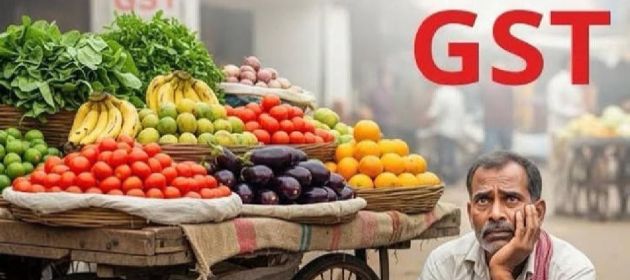
Why did GST notices go out to vendors of vegetables, which is not subject to GST?
That’s unfortunate but it’s a feature, not bug, of UPI.
The narration of a UPI payment does not include details of merchant category. Accordingly, when GST Department receives the UPI data, it has no way to know that the merchant sells vegetables. It can learn that only after it sends the notice to the vendor and the vendor replies back saying he sells vegetables. In other words, merchant category is known only ex post facto, so GST notices are inevitable even for exempt category of small merchants whose UPI collections exceed the GST revenue thresholds.
The same logic applies to small merchants who received GST notices because their receipts from lenders and family members via UPI were treated as sales.
On a side note, this problem does not exist with credit card. In addition to the transaction amount, a credit card narration also relays the Merchant Category Code (MCC), based on which it’s possible for GST Department to know ex-ante that the merchant belongs to the exempt vegetable category and refrain from sending a notice to him in the first place.
12. Simplify GST compliance
From personal experience, I totally agree that GST compliance is a PITA. But I’m not sure if it can be substantially simplified in the present form of GST that seeks line item-level matching of invoices across multiple enterprises. Singapore attempted this but, despite its business and tech savvy bureaucracy, abandoned the lofty goal and settled for aggregate invoice-level tracking. Ergo, by its very nature, Indian GST is complex and compliance will be cumbersome.
That said, presumably based on such feedback, GST Department introduced a simplified – although more diluted – alternative called Composition Scheme, which does simplify GST compliance.
13. Composition Scheme
Can GST Composition Scheme work for small merchants?
Under the GST Composition Scheme, a merchant does not qualify for the standard Levy-Collect-Remit paradigm. Instead, he pays a fixed percentage of his turnover at a concessional rate to the government without levying GST to the consumer. The rate is 1% for traders, 2% for manufacturers, and 5% for restaurants. In other words, a composition dealer pays GST out of his own pocket.
On the face of it, people might think Composition Scheme won’t work for small merchants under the belief that their margins are very low and won’t permit them to absorb any level of GST. This is not true. Firstly, the subtext of point #8 above is that margins of small merchants is not all that low. Secondly, small merchants are free to increase their base price to compensate for the GST burden since their business is not subject to MRP or price control regime e.g. if a streetside food stall was selling a plate of bhel puri at INR 100, he can hike the base price to INR 101. (although a composition dealer cannot charge GST separately / additionally on the invoice.)
14. Threat to Financial Inclusion
UPI may be a matter of convenience for J6P but, from the government’s point-of-view, UPI is supposed to boost financial inclusion and drive formalization of economy, and thereby plug tax leakages. Therefore, it makes no sense to promote financial inclusion and formalization of economy without realizing more taxes.
While on the subject, there’s ton of buzz on social media that taxes are very high in India. This popular narrative not only dissonates with my personal experience in UK and Germany but also runs counter to the latest available data given in the following exhibit.
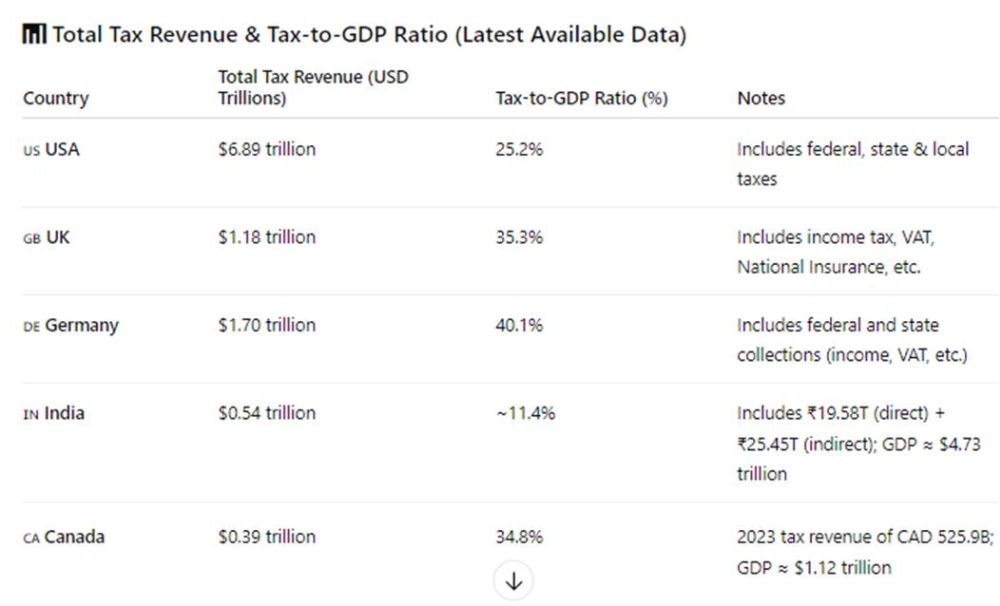
As you can see, India has a way lower Tax-to-GDP ratio (11.4%) compared to other trillion dollar economies like USA (25.2%), Canada (34.8%), UK (35.3%) and Germany (40.1%).
This is a continuously unfolding topic. I’ll cover any emerging issues in a follow-on post or two.
DISCLAIMER: Nothing in this blog post is legal, tax or pricing advice.