When you get off at London Heathrow airport (LHR), you can reach the Heathrow Tube stations without going to the street level.
Without leaving the building of Frankfurt Airport (FRA), you can not only reach the Airport (Flughafen) Station of the intracity S-Bahn public transport network but also of the intercity long distance rail network.
In Pune, you can interchange between the Aqua Line and Purple Line without leaving the Civil Court station. You can also buy a single ticket to travel on both lines of Pune Metro.
These rapid transit networks feel “integrated”. For want of a better expression, I’ll call them “Integrated Metro”.
Now, let’s come to Mumbai Metro.
On a recent visit to drop someone at Mumbai Airport (BOM) Terminal 2, I decided to check out the newly opened Mumbai Metro Line 3 aka Aqua Line that calls on T2.
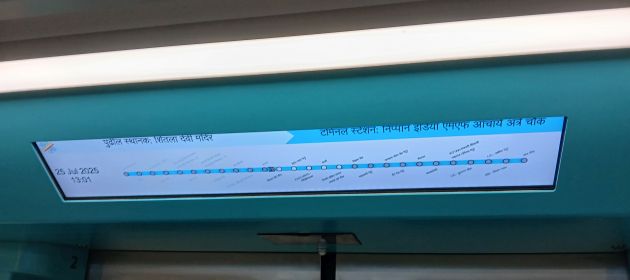
From the arrivals level of T2, I followed the sign for the metro, left the airport building, walked for 250-300 meters on public streets, and reached the entrance of CHHATRAPATI SHIVAJI MAHARAJ MUMBAI INTERNATIONAL AIRPORT T2 Metro Station. It took me around 15 minutes to walk from T2 arrivals to CSMI Airport-T2 Metro station. I believe the distance is 500 meters. It was no big deal since I had no luggage and hadn’t traveled hours before landing at the airport. But I can see how a typical air traveler will not find it too convenient to go from the airport to the metro station. Besides, it rains heavily for four months in a year in Mumbai, so there’s that.
It’s not only the airport. I believe passengers need to go to street level at most interchange stations of Mumbai Metro to change lines. Also, each line requires a separate ticket.
Against this backdrop, it’s fair to say that Mumbai Metro is not integrated in the same manner as London Tube, Frankfurt S-Bahn or Pune Metro rapid transit systems.
Before digging more deeply into this point, let me make a few observations about Mumbai Metro Line 3 based on my datapoint of one ride:
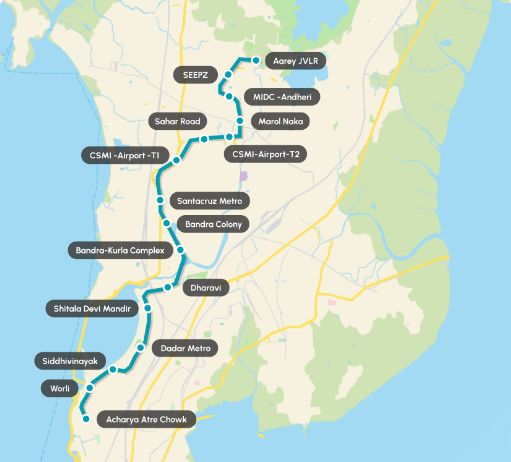 In the currently operational phase, the line goes from AAREY (JVLR) in North West Mumbai to ACHARYA ATRE CHOWK (Worli Naka) in Central Mumbai. In the next phase, it will proceed to CUFFE PARADE in South Mumbai (not shown in the map).
- It’s 100% underground, with one section going below water.
- Most stations are sponsored by companies e.g. Kotak BKC, SBI Dadar, ICICI Lombard Siddhi Vinayak, Nippon India MF Acharya Atre Chowk. But not all e.g. Dharavi, Shitladevi Temple.
- Interestingly, all the corporate sponsors are in the BFSI industry e.g. ICICI Bank, Kotak Mahindra Bank, Nippon India Mutual Fund, State Bank of India. Not sure if it’s a nod to Mumbai being considered as the finance capital of India.
- Mumbai is always known for the rich and poor coexisting side by side. With BKC and Dharavi stations next to each other, Mumbai Metro seems to reflect that ethos. For the uninitiated, BKC is the most expensive commercial real estate in India and Dharavi is the largest slum in India (if not Asia).
- The trains run at fairly high speed. This is probably because the entire line is underground. (That rhymes with Pune Metro, where I noticed that trains run faster on the underground section than the overground section). I didn’t keep a track of my trip duration but, according to YoMetro, it’s around 20 minutes, which seems about right. What I do remember is that the stations came in rapid succession one after the other.
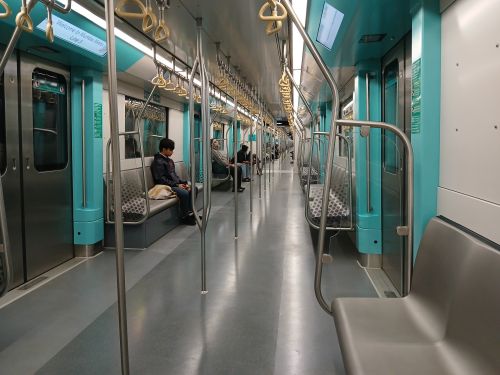 I got in at T2 and got off at Acharya Atre Chowk at a peak time on a regular working day. I noticed that both stations and the train were quite empty. I guess it’s early days for Line 3. The people standing in the BEST bus line at T2 whom I asked for directions told me that the nearest metro station was too far to walk and advised me to take an auto rickshaw to go there. They didn’t even know that there was a metro station right next to them! They were presumably thinking of the SAHAR ROAD metro station on Mumbai Metro Line 1, which has been operational for over 10 years. When I took Line 1 around 7-8 years ago, the stations and trains were not very crowded whereas I believe that they’re chock-a-block now and nearly as crowded as Mumbai local trains.
- All stations had Platform Screen Doors. PSD is a physical barrier between the train and the platform. It opens and closes in sync with train doors to allow safe boarding and alighting. Made of acrylic panels, it prevents falls onto the tracks, improves air conditioning efficiency, and reduces litter and debris on the tracks.
When I interchanged between the Circle Line and DLR in London, I remember taking a fairly long walkway between Monument and Bank stations. Per ChatGPT, Monument station was opened in 1884, Bank station was opened in 1900, and the Monument-Bank Walkway was constructed in 1933. So, for 33 years, these stations were not internally connected and Londoner commuters had to get to street level to go from one station to the other.
It won’t take that long for Mumbai Metro to become integrated!
According to news reports, an enclosed walkway is already being built between T2 airport terminal and metro station. There are plans to have a forecourt above Metro Line 3 integrating directly with T2 airport building by the end of 2026.
tl;dr: Metro integration is a journey rather than a destination.